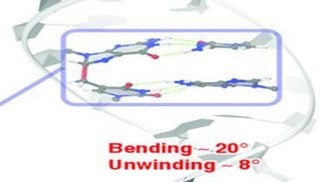
Insights into Intrastrand Cross-Link Lesions of DNA from QM/MM Molecular Dynamics Simulations. DNA damages induced by oxidative intrastrand cross-links have been the subject of intense research during the past decade. Yet, the currently available experimental protocols used to isolate such lesions only allow to get structural information about linked dinucleotides. The detailed structure of the damaged DNA macromolecule has remained elusive. In this study the group of Ursula Röthlisberger (Laboratory of Computational Chemistry and Biochemistry), in collaboration with researchers of Lyon, generated in silico the most frequent oxidative intrastrand cross-link adduct, G[8,5-Me]T, embedded in a solvated DNA dodecamer by means of quantum mechanics/molecular mechanics (QM/MM) Car-Parrinello simulations. The free energy of activation required to bring the reactant close together and to form the C-C covalent-bond is estimated to be 10 kcal/mol. They observe that the G[8,5-Me]T tandem lesion is accommodated with almost no perturbation of the Watson-Crick hydrogen-bond network and induces bend and unwinding angles of 20° and 8°, respectively.
TO READ THIS ARTICLE, CREATE YOUR ACCOUNT
And extend your reading, free of charge and with no commitment.
Your Benefits
- Access to all content
- Receive newsmails for news and jobs
- Post ads