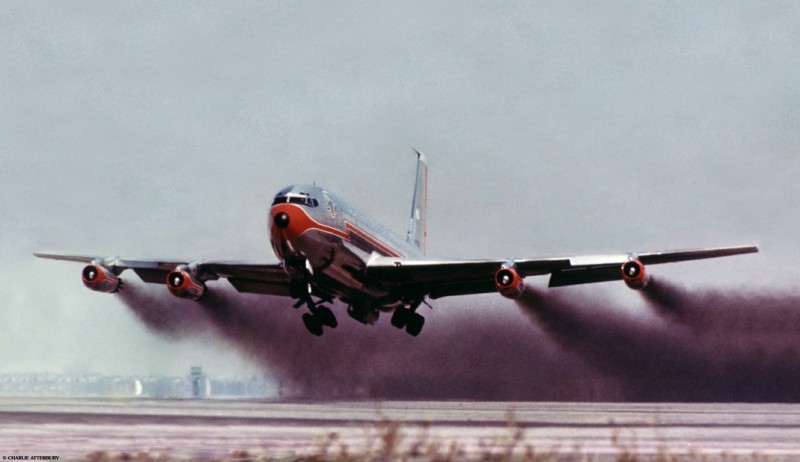
Aircraft engines emit soot. This Boeing 707 leaves quite a visible cloud in June 1960, taking off from runway 25L at Los Angeles International. Today’s soot particles are much smaller, but still there. Empa scientists developed a method for measuring these emissions, which was just approved by the International Civil Aviation Organisation ICAO. So aircraft engines will become cleaner in the next years. Picture: Charlie Atterbury, Seattle
Thanks to a close collaboration between the Swiss Federal Laboratories for Materials Science and Technology (Empa), SR Technics and the Federal Office of Civil Aviation (FOCA), Switzerland is setting an international benchmark by developing a method for measuring emissions of fine particulate matter from aircraft engines. The Committee on Aviation Environmental Protection of the International Civil Aviation Organization (ICAO) recently approved a preliminary standard governing the emission of particulates by aircraft engines. Since the 1980s, large aircraft engines have been required to meet emission limits that have been gradually tightened over time. Air traffic, therefore, contributes relatively little to Switzerland's pollution levels, and visible smoke trails in the sky from jet engines are a thing of the past. However, no-one has yet found a solution to the emission of ultra-fine particles from jet engines. These microscopically small particles can penetrate deep into the lungs and thus adversely affect health. As a precautionary measure, these emissions from air traffic will now also be measured, regulated and reduced, even though air traffic produces less than 1 percent of Switzerland's fine particulate emissions.
TO READ THIS ARTICLE, CREATE YOUR ACCOUNT
And extend your reading, free of charge and with no commitment.