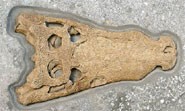
This stunning specimen shows that there’s plenty of life in the Dorset Jurassic - these must be some of the most heavily collected rocks in the world, and yet it’s wonderful to see a new species coming out.
A superbly preserved 130-million-year-old crocodile skull, discovered at Swanage in Dorset in 2009, has been described as belonging to a species new to science in a paper by researchers at the University of Bristol. The specimen has been given the name Goniopholis kiplini after Rudyard Kipling, author of The Just So Stories , in recognition of his enthusiasm for the natural sciences. The skull was discovered in April 2009 by Richard Edmonds, Earth Science Manager with the Jurassic Coast World Heritage Site Team , in the course of regular site monitoring. After obtaining the necessary permissions from Natural England and Swanage Town Council, it was excavated by Richard with local collectors Steve Etches and Chris Moore and then carefully prepared, by Chris and Alex Moore in their workshop at Charmouth with funding from the Jurassic Coast Trust. It soon became apparent that this stunning specimen was something of very considerable scientific interest and, as a result, it was loaned to the University of Bristol where PhD student, Marco Brandalise de Andrade carefully studied and compared it to known specimens from all over the world. Additional preparation was undertaken at Bristol by Remmert Schouten and a CT scan made in order to be able to study structures contained deep within the fossil. As a result of that work, the new identification has been accepted and published in the Zoological Journal of the Linnean Society.
TO READ THIS ARTICLE, CREATE YOUR ACCOUNT
And extend your reading, free of charge and with no commitment.