Artificial intelligence, blockchain and quantum computing are considered key technologies of the future. A representative study by Lucerne University of Applied Sciences and Arts shows for the first time how the Swiss population perceives these technologies in comparison. The results are clear: people in Switzerland are both open-minded and cautious about these future technologies. They expect politicians to both actively promote Switzerland as a business location in order to strengthen competitiveness and to protect against potential dangers and risks.
Artificial intelligence (AI), blockchain and quantum computing are becoming increasingly important for the economy, society and politics in Switzerland. However, the public debate on these technologies is often characterized by extreme positions: "Futurists, for example, describe AI in their bestsellers either as a guarantor of future prosperity or as an existential risk for humanity," says study author Philipp Bachmann from the Lucerne University of Applied Sciences and Arts. This makes it all the more important to know what the Swiss population really thinks about these three basic technologies. A study by Lucerne University of Applied Sciences and Arts examined awareness, understanding, attitudes and political expectations in comparison for the first time. "Swiss politicians are committed to promoting AI, blockchain and quantum computing. Against this backdrop, it is crucial to know to what extent the population is aware of these enabling technologies and what expectations they have of politicians," says study author Philipp Bachmann.
Artificial intelligence best known
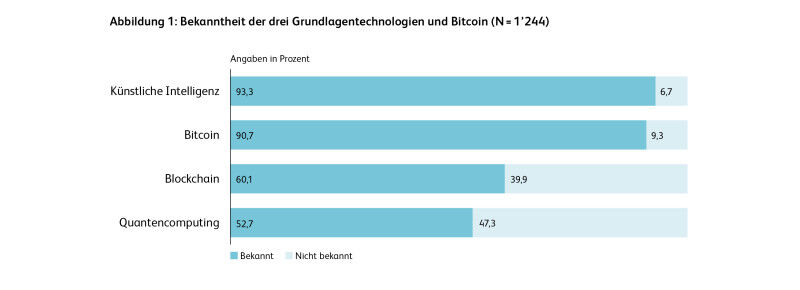
The study is based on a representative survey of 1,244 people from German-speaking and French-speaking Switzerland. In addition to the three technologies, attitudes towards Bitcoin as a specific application of blockchain technology were also surveyed. There are clear differences in the awareness of the technologies surveyed. Artificial intelligence is the best known: 93% of respondents have already heard of it. A similarly high figure of 91% was recorded for Bitcoin. By contrast, blockchain, the basic technology behind the world’s strongest cryptocurrency, is less well known: Only around 60 percent of respondents are familiar with the term. Quantum computing is even less familiar: only around half of respondents (53%) are familiar with the term.
Little knowledge of blockchain
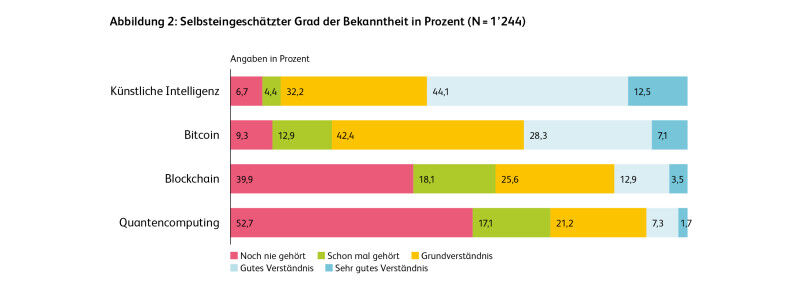
There are major differences not only in terms of familiarity, but also in terms of understanding: respondents are also most familiar with AI: more than half say they understand this technology well or very well (57%); only 11% have little or no knowledge of the term. Knowledge of blockchain and quantum computing is significantly lower: only 16% of respondents rate their knowledge of blockchain as good or very good; for quantum computing, the figure is just 9%.
Great skepticism towards Bitcoin
In addition to knowledge and understanding, the research team also investigated enthusiasm for the individual technologies and how threatening they are perceived to be. Quantum computing combines high enthusiasm with a low threat perception, while Bitcoin has low enthusiasm with pronounced skepticism. "Bitcoin is repeatedly in the headlines in connection with international crime and money laundering, as are the open answers. Accordingly, the respondents’ assessment of Bitcoin is negative," says Philipp Bachmann.
Artificial intelligence and blockchain are somewhere in between: they arouse interest, but also cause concern, especially among people with little knowledge of the subject. "The level of knowledge clearly shapes this picture: more knowledge about the respective technologies goes hand in hand with more approval and a lower perception of threat, without making it disappear completely," says Philipp Bachmann. It is therefore crucial that educational institutions in particular show how blockchain works, for example, where this technology is already being used today and what impact it can have on society.
Politics should minimize risks
The results of the study also show clear expectations of Swiss politics across all technologies and age, education and gender boundaries. "The population wants the state to play an active role: it should promote innovation, limit risks and protect the population," says Philipp Bachmann. In the case of artificial intelligence and blockchain, protective and precautionary measures are particularly important. In the case of quantum computing, the focus is more on promoting innovation and competitiveness. On the other hand, there is generally little support for as little political regulation of future technologies as possible.
About the study "Key technologies from the perspective of the Swiss population "
The Institute of Communication and Marketing (IKM) at Lucerne University of Applied Sciences and Arts developed the questionnaire for a representative survey of the population. DemoSCOPE AG, a leading Swiss social and market research company, carried out the data collection in June and July 2025. The sample comprised 1,244 people from German-speaking and French-speaking Switzerland.
Lucerne University of Applied Sciences and Arts: futurology for practice
The Lucerne University of Applied Sciences and Arts teaches and researches future technologies (AI, blockchain, quantum cryptography) and translates complex research into applicable solutions. Specialized competence centers such as the Applied AI Center and the Quantumlab develop concrete applications. HSLU and the University of Lucerne have also been part of the Blockchain Zug Joint Research Initiative since 2024. The Canton of Zug is contributing a total of CHF 39.35 million to the development costs of this joint project over five years. The aim is to make Zug a world-leading center for blockchain research.