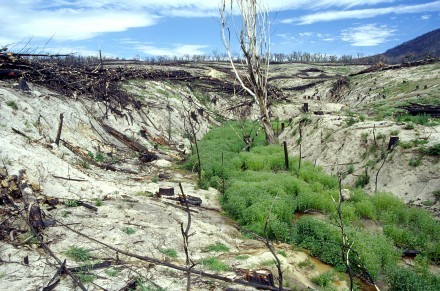
Heavily cut area, post-fire in the wet forests of the Australian Capital Territory, showing losses of large old trees, stream erosion and weed invasion. Photo by David Lindenmayer.
Ecosystems worldwide are in danger of losing large, old trees forever, without more research and policy changes to better protect them, warns a new study published in Science today. Lead author of the paper, Professor David Lindenmayer from the Fenner School of Environment and Society in the ANU College of Medicine, Biology and Environment, says the threats these trees face are manifold and populations around the world are rapidly declining. "Just as large-bodied animals such as elephants, tigers, and cetaceans have declined drastically in many parts of the world, a growing body of evidence suggests that large old trees could be equally imperilled," said Lindenmayer. "Targeted research is urgently needed to better understand the key threats to their existence and to devise strategies to counter them. Without such initiatives, these iconic organisms and the many species dependent on them could be greatly diminished or lost altogether." The study outlines the unique ecological roles large old trees play, roles that younger and smaller tress cannot fulfil. "Large old trees in Mountain Ash forests of mainland Australia, for example, provide irreplaceable shelter and nesting sites for over 40 species, therefore their decline could have serious implications for ecosystem integrity and biodiversity," said Lindenmayer. "They also store large quantities of carbon and play significant roles in local hydrological regimes, disruptions to which are of global concern.
TO READ THIS ARTICLE, CREATE YOUR ACCOUNT
And extend your reading, free of charge and with no commitment.