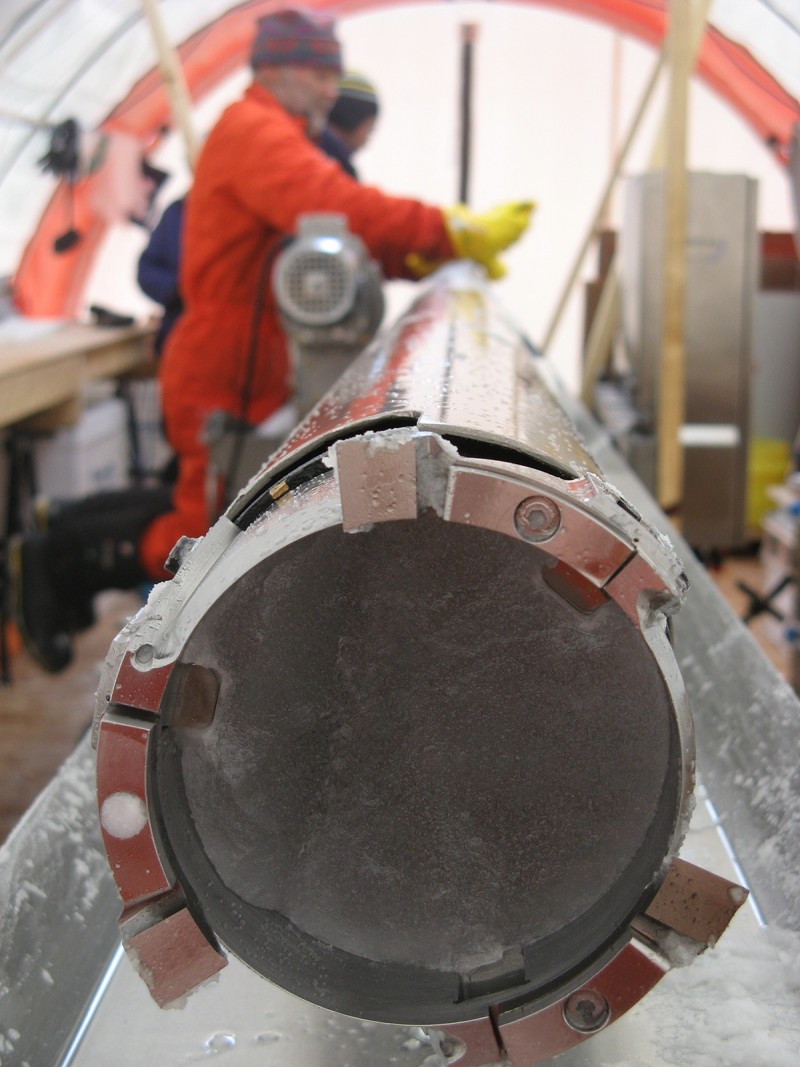
Ice core drilling in Antarctica. Ice cores contain important climate information, for example the atmospheric concentration of CO2. The EPICA project, with participation of the University of Bern, has obtained the oldest ice core so far, providing climate information over the last 800.000 years. Credit: Nerillie Abram.
Selected intervals in the past that were as warm or warmer than today can help us understand what the Earth may be like under future global warming. A latest assessment of past warm periods, published by an international team of 59 scientists from 17 nations, shows that in response to the warming ecosystems and climate zones will spatially shift and on millennial time scales ice sheets will substantially shrink. The study was an outcome of a workshop that took place in Bern and was coordinated by the University of Bern in Switzerland, the University of New South Wales in Australia, and Oregon State University in the United States. The compiled evidence from the past suggests that even with a global warming limited to within 2°C above preindustrial levels, as aimed at in the Paris Agreement, climate zones and ecosystems will shift, rapid polar warming may release additional greenhouse gases, and sea-level will rise by several meters over several thousand years. These observations show that many current climate models designed to project changes within this century may underestimate longer-term changes. Over the past 3.5 million years, several time intervals are known for being 0.5-2°C warmer than the so-called preindustrial temperatures of the 19th century. These intervals reveal much stronger regional warming at high latitudes than in the tropics, similar to what models predict for a 2°C global warming by the year 2100. Although not all these past warmings were caused by higher CO2 concentrations, they are helpful to assess the regional effect of a warming of a scale comparable to that aimed at in the Paris Agreement. Ecosystems and climate zones will shift
TO READ THIS ARTICLE, CREATE YOUR ACCOUNT
And extend your reading, free of charge and with no commitment.