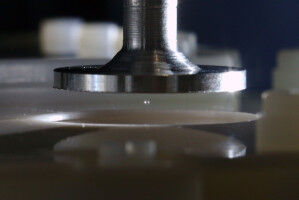
Publishing in Nature, EPFL scientists show how light affects perovskite film formation in solar cells, which is a critical factor in using them for cost-effective and energy-efficient photovoltaics. Perovskites are materials of immense interest in solar energy technology lately, as they promise to bring down the cost of solar cells to very low levels. Their efficiency heavily depends on our ability to control their deposition into films, but the factors that influence the synthesis of perovskites are not well understood. EPFL scientists have now shown that, in the two most common methods used today, light can greatly accelerate the formation of perovskite films and control the morphology of their crystals, thus influencing the efficiency of the resulting solar cell. The breakthrough study is published in Nature . The research was carried out by the lab of Michael Grätzel at EPFL. Grätzel is world-renowned for inventing the first dye-sensitized solar cells (Grätzel cells) that revolutionized solar-energy science. In this paper, PhD student Amita Ummadisingu and her colleagues at Grätzel's lab used confocal laser scanning fluorescence microscopy and scanning electron microscopy to examine how direct light affects the crystal formation when depositing perovskites in layers, as is usually done to build a solar cell.
TO READ THIS ARTICLE, CREATE YOUR ACCOUNT
And extend your reading, free of charge and with no commitment.
Your Benefits
- Access to all content
- Receive newsmails for news and jobs
- Post ads