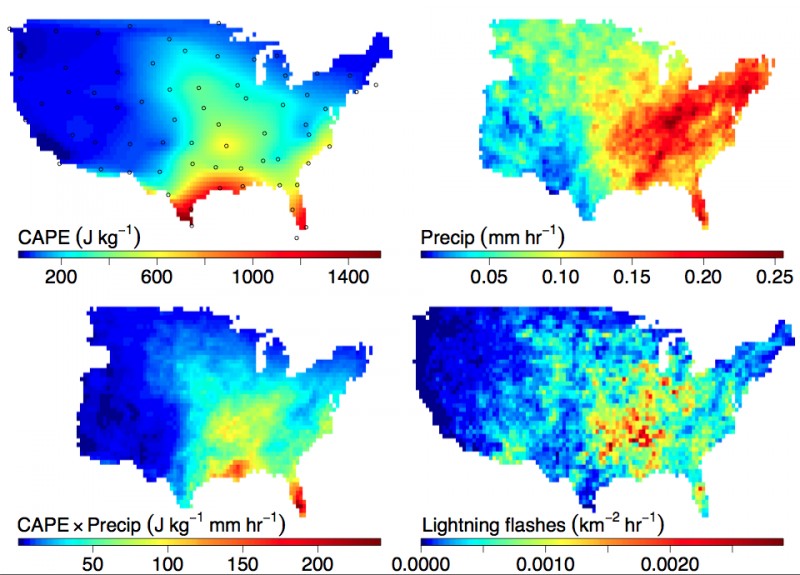
For the year 2011, maps of mean (top left) CAPE from the SPARC radiosonde data, (top right) precipitation from the NWS RFC data, (bottom left) product of the top two maps, and (bottom right) CG lightning from the National Lightning Detection Network data.
Today's climate models predict a 50 percent increase in lightning strikes across the United States during this century as a result of warming temperatures associated with climate change. Reporting in the Nov. 14 issue of the journal Science , climate scientist David Romps of Lawrence Berkeley National Laboratory and the University of California, Berkeley, and his colleagues look at predictions of precipitation and cloud buoyancy in 11 different climate models and conclude that their combined effect will generate more frequent electrical discharges to the ground. "With warming, thunderstorms become more explosive,” said Romps, an assistant professor of earth and planetary science. "This has to do with water vapor, which is the fuel for explosive deep convection in the atmosphere. Warming causes there to be more water vapor in the atmosphere, and if you have more fuel lying around, when you get ignition, it can go big time. More lightning strikes mean more human injuries; estimates of people struck each year range from the hundreds to nearly a thousand, with scores of deaths.
TO READ THIS ARTICLE, CREATE YOUR ACCOUNT
And extend your reading, free of charge and with no commitment.