NEES
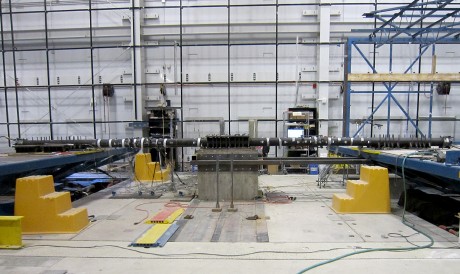
Cornell civil engineers report that retrofitting pipelines with "cured-in-place pipe" (CIPP) linings - flexible tubular membranes saturated with thermosetting resin - would prevent earthquake damage to seismically vulnerable, 50- to 100-year-old cast iron U.S. pipelines. Their findings would allow public and private utilities to take advantage of improvements in seismic resistance and to renovate aging pipelines that make up an important part of the country's critical civil infrastructure. The research - conducted by principal investigator Thomas O'Rourke, the Thomas R. Briggs Professor in Engineering; Cornell earthquake engineers; and a team from State University of New York at Buffalo - was presented at Quake Summit 2014, the annual meeting for the National Science Foundation's George E. Brown Jr. Network for Earthquake Engineering Simulation, a shared network of laboratories based at Purdue University. This year's summit was part of the 10th U.S. National Conference on Earthquake Engineering, July 21-25 in Anchorage. A CIPP lining can be installed in water and wastewater pipelines without digging them up. The technique involves the remote installation of fiber-reinforced polymer (FRP) linings inside underground pipelines through trenchless construction procedures.
TO READ THIS ARTICLE, CREATE YOUR ACCOUNT
And extend your reading, free of charge and with no commitment.