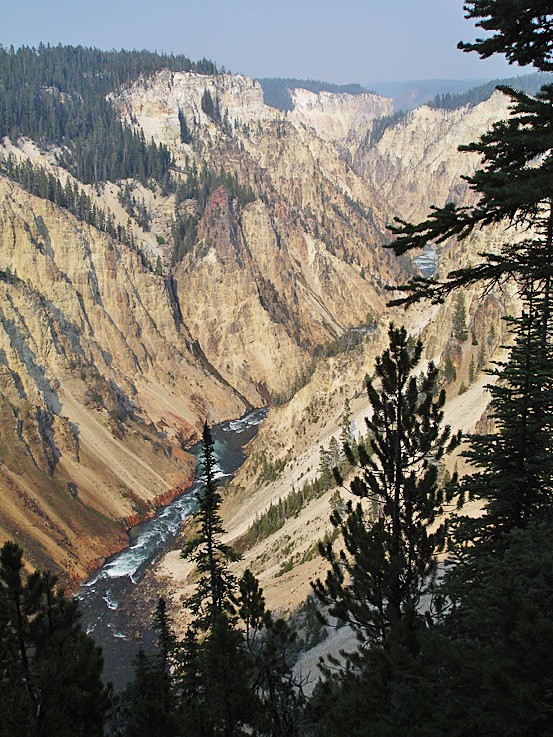
Sarah Gelman/UW The formations in the Grand Canyon of the Yellowstone, in Yellowstone National Park, are an example of silica-rich volcanic rock.
Reservoirs of silica-rich magma - the kind that causes the most explosive volcanic eruptions - can persist in Earth's upper crust for hundreds of thousands of years without triggering an eruption, according to new University of Washington modeling research. That means an area known to have experienced a massive volcanic eruption in the past, such as Yellowstone National Park, could have a large pool of magma festering beneath it and still not be close to going off as it did 600,000 years ago. "You might expect to see a stewing magma chamber for a long period of time and it doesn't necessarily mean an eruption is imminent,” said Sarah Gelman, a UW doctoral student in Earth and space sciences. Recent research models have suggested that reservoirs of silica-rich magma, or molten rock, form on and survive for geologically short time scales - in the tens of thousands of years - in the Earth's cold upper crust before they solidify. They also suggested that the magma had to be injected into the Earth's crust at a high rate to reach a large enough volume and pressure to cause an eruption. But Gelman and her collaborators took the models further, incorporating changes in the crystallization behavior of silica-rich magma in the upper crust and temperature-dependent heat conductivity. They found that the magma could accumulate more slowly and remain molten for a much longer period than the models previously suggested.
TO READ THIS ARTICLE, CREATE YOUR ACCOUNT
And extend your reading, free of charge and with no commitment.