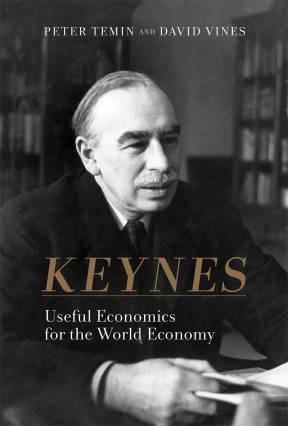
The cover of "Keynes: Useful Economics for the World Economy," written by Peter Temin, an MIT economic historian, and David Vines, a of economics at Oxford University, and published this month by MIT Press.
In 1919, when the victors of World War I were concluding their settlement against Germany - in the form of the Treaty of Versailles - one of the leading British representatives at the negotiations angrily resigned his position, believing the debt imposed on the losers would be too harsh. The official, John Maynard Keynes, argued that because Britain had benefitted from export-driven growth, forcing the Germans to spend their money paying back debt rather than buying British products would be counterproductive for everyone, and slow global growth. Keynes' argument, outlined in his popular 1919 book, "The Economic Consequences of the Peace," proved prescient. But Keynes is not primarily regarded as a theorist of international economics: His most influential work, "The General Theory of Employment, Interest, and Money," published in 1936, uses the framework of a single country with a closed economy. From that model, Keynes arrived at his famous conclusion that government spending can reduce unemployment by boosting aggregate demand. But in reality, says Peter Temin, an MIT economic historian, Keynes' conclusions about demand and employment were long intertwined with his examination of international trade; Keynes was thinking globally, even when modeling locally. "Keynes was interested in the world economy, not just in a single national economy," Temin says.
TO READ THIS ARTICLE, CREATE YOUR ACCOUNT
And extend your reading, free of charge and with no commitment.