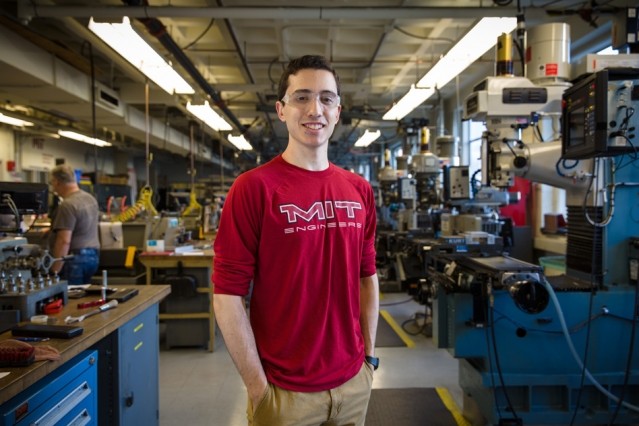
‘The challenge is to design devices that can be made for a much lower cost, but that are still as robust and functional as those in the developed world,’ senior Matthew Cavuto says.
Matthew Cavuto, now a senior in MIT's Department of Mechanical Engineering, embarked on his career path partly as a result of a talk he heard in high school by MIT Professor Hugh Herr, a double amputee who works on improving prosthetic devices and systems to allow people with similar disabilities to regain as much control, independence, and capability as possible. Herr 'gave an awesome talk about the work he was doing in his field. It both piqued my interest in MIT and made me want to tackle similar problems in my studies,' Cavuto recalls. Now, thanks to a Marshall Scholarship that will provide him with two years of graduate studies in England, Cavuto will be taking that interest to the next level. He plans one year of work at Imperial College London, with one of the world's leading research teams on providing sensory feedback to users of prosthetic limbs, and then a year at Cambridge University with a leading team developing devices known as exoskeletons, to restore mobility to patients with paralysis. Cavuto knows a thing or two himself about graceful, highly controlled mobility: He spends his free time in high-level competitive ballroom dancing and varsity fencing, two very different but equally demanding disciplines that are based on precision movement. Even as an undergraduate, Cavuto has made some significant progress in providing mobility for some amputees in developing countries.
TO READ THIS ARTICLE, CREATE YOUR ACCOUNT
And extend your reading, free of charge and with no commitment.