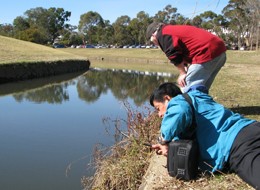
Dr Paul Cooper and Dr Thanit Pewnim collect data at Sullivans Creek. Photo by Warangkhana Pruksarojanakul.
The tiny living organisms that call Sullivans Creek home were not fans of the recent storm water flood. During the heavy rain in February, the normally slow-flowing creek became a river, as a huge volume of water channeled through the University and into Lake Burley Griffin. During the flood, the many animals that call Sullivans Creek home fled for cover, says Thanit Pewnim, a visiting fellow in the Research School of Biology. Working with Paul Cooper and PhD student Warangkhana Pruksarojanakul, Pewnim has been studying how the creek's smallest creatures - microcrustaceans - sense and respond to the changing environments of the creek. "During the stormy period at the end of February, the black swans, ducks and frogs all sought refuge, avoiding the rapid-like conditions," Pewnim said. "One thing we know for certain is that the microcrustaceans do not like the storm water any more than these larger animals, as they were also hiding during this turbulent time. "Each time the flow increases, these tiny animals become more difficult to find, either because they hide within the vegetation in the creek or because they are simply washed out into the lake."
TO READ THIS ARTICLE, CREATE YOUR ACCOUNT
And extend your reading, free of charge and with no commitment.