


Message from
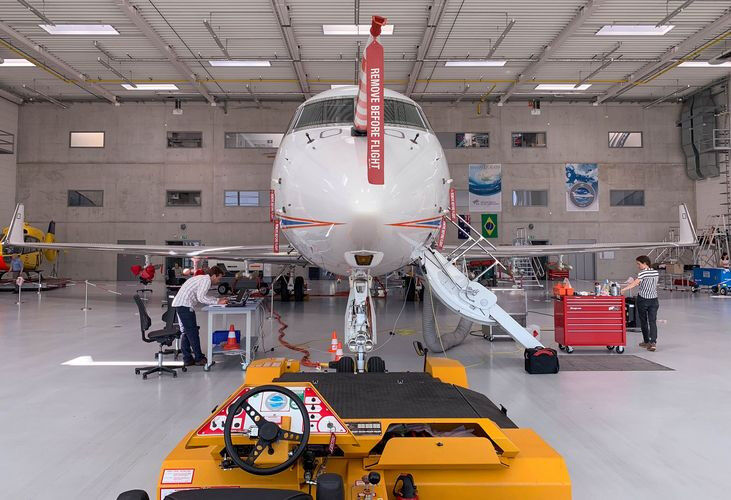
When it comes to clouds, the region in the far south of New Zealand (Aotearoa) is unique in the world: it is one of the most untouched, cleanest and yet accessible regions in the world. An international consortium involving the Leibniz Institute for Tropospheric Research (TROPOS) and the University of Leipzig will therefore be studying the clouds in this region in detail for a year and a half during the "goSouth-2" campaign. As part of goSouth-2, Project ACADIA, which is funded by the German Research Foundation (DFG), will investigate in particular the influence of small changes in air quality on cloud formation. The German research aircraft HALO is currently being prepared for deployment in New Zealand at its home base at the German Aerospace Center (DLR) in Oberpfaffenhofen.
During the "HALO-South" mission, the researchers want to study the interaction of clouds, aerosols and radiation over the Southern Ocean from September. To this end, HALO will undertake five weeks of measurement flights from Christchurch over the oceans of the clean Southern Hemisphere. "We hope that we can make an important contribution to closing this gap with the large-scale HALO-South measurement campaign," explains campaign leader Prof. Mira Pöhlker from TROPOS and Leipzig University. "We are very pleased to have so many experienced experts on board to help us answer questions such as: What aerosols are there in the Southern Ocean? Where do they come from? How do they change the clouds?" says Pöhlker. The researchers hope that the measurements will not only provide important data for optimizing weather forecasts and climate models in the little-studied South, but also a better basic understanding of how the atmosphere and clouds will react to a decline in emissions in the coming decades. The aircraft measurements during "HALO-South" are mainly funded by the DFG, with contributions from the Max Planck Institute for Chemistry (MPIC) and the German Aerospace Center (DLR). They are the prelude to intensive research cooperation between Germany and New Zealand.
Clean air in the south as a challenge for climate models
The remote sensing observations from the ground are an important link between the "HALO-South" aircraft mission of the HALO research aircraft in September and October 2025 and the expeditions of the German research vessels Sonne and Polarstern planned for 2027/28, all of which will investigate the atmosphere of the Southern Ocean at the edge of Antarctica. The weather service MetService New Zealand and the University of Canterbury in Christchurch (Otautahi) are also significantly involved in the projects.
The clouds over the southern tip of the South Island of New Zealand are mainly influenced by the sea when the air masses from the south move from Antarctica and the Southern Ocean towards New Zealand. Large continental emission sources such as mineral dust, forest fire smoke or man-made contributions from industry and traffic do not exist along this pathway. On the other hand, there are also episodes of dusty and human-polluted air when the air masses move over Australia to New Zealand or when forest fire smoke is transported from Africa or even South America at high altitudes. It is probably the great contrasts in air pollution that present weather and climate models with as yet unresolved challenges. The quality of cloud cover forecasts over the southern hemisphere is still worse than for the northern hemisphere. This is suspected to be due to the prevailing clean air with a lack of aerosol particles, which are needed as nucleation nuclei for cloud droplets or ice crystals.
Seven years of preparation for large measurement campaigns at the edge of the Southern Ocean

Preparations have been underway since 2018 for the major atmospheric research project, which will collect detailed data on aerosols, clouds and precipitation that the global climate modeling community urgently needs over the coming months. The campaign is called "goSouth-2" because there was already a first test campaign "goSouth" in 2022 together with the National Institute of Water and Atmospheric Research (NIWA) in New Zealand.
"We scan the distribution and movement of aerosol and cloud particles in the atmosphere above us several times a minute with an accuracy of a few meters. This enables us to distinguish between the various components such as ice crystals, cloud droplets or the different types of aerosol. This forms the basis for all subsequent investigations into the interactions between aerosols and clouds," explains Patric Seifert from TROPOS. "As the radars used also record the profiles of precipitation particles, the influence of the different air masses on rain formation can also be investigated," says Prof. Heike Kalesse-Los from Leipzig University.
The location at the southern tip of the South Island is ideal for characterizing the original clean air from the Antarctic and the Southern Ocean. Nevertheless, the researchers expect air masses from Australia that are more heavily polluted with aerosol particles around 25 percent of the time. "This contrast will allow us to make detailed comparisons, as an initial analysis of long-term lidar measurements from Lauder, New Zealand, has already shown," explains Patric Seifert. The aim of "goSouth-2" is a detailed contrast study of cloud properties in clean Antarctic air versus clouds in aerosol-polluted Australian air. Such an investigation is the key to a better understanding of the possible variability of clouds under changing aerosol conditions. To this end, the team led by Patric Seifert and Heike Kalesse-Los from the University of Leipzig has received funding from the German Research Foundation (DFG) for
Accompanying ground measurements at Leipzig University
In addition to their collaboration in the ACADIA project, the researchers from Leipzig University will accompany the "HALO South" flight campaign with additional measurements at the Tawhaki National Aerospace Center on the eastern side of the South Island of New Zealand over the coming months. The LIMRAD94 cloud radar from Leipzig University was shipped to New Zealand with the TROPOS containers. In addition, several radiosondes (weather balloons) will be launched from Tawhaki on each HALO flight day. The ground measurements at Invercargill Airport (Waihopai) and the Tawhaki National Aerospace Centre are also part of the EU CleanCloud project, which is investigating the interactions between aerosols and clouds to improve our understanding of climate dynamics in a constantly changing world.


