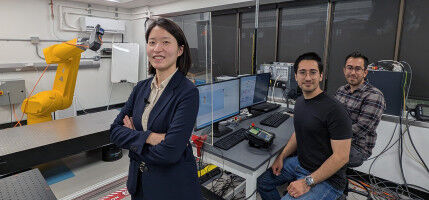
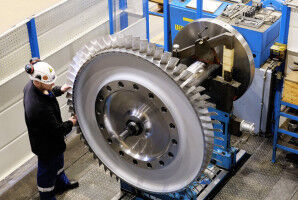
MIT Gas Turbine Laboratory prepares to jet into the future
With 75 years of aviation industry-focused research and education under its belt, the lab continues to develop propulsion systems for next-generation aircraft. Close In 1941, the National Academy of Sciences appointed a committee to assess the use of gas turbine engines - which use heat released during fuel combustion to produce thrust for propulsion - in aviation. The group of luminaries concluded that due to the temperature limitations of existing materials, gas turbines did not have much of a future in propelling airplanes. However, "Unknown to the committee, the first jet engine was already successfully run in Germany in 1940: the Junkers Jumo," says Professor Zoltán Spakovszky , director of the MIT Gas Turbine Laboratory (GTL) and the T.A. Wilson Professor in Aeronautics and Astronautics. Although the committee had correctly identified the temperature limitations, "the German engineers and designers redefined the problem and introduced turbine cooling," he explains. The Junkers Jumo, the world's first turbojet engine in production, was put in operation during World War II, while separately, Sir Frank Whittle had been leading progress on the development of the turbojet engine in Great Britain. With the United States falling behind Germany and Britain in developing turbojet engines, Professor Jerome C. Hunsaker had the vision of establishing a laboratory dedicated to gas turbine propulsion at MIT.