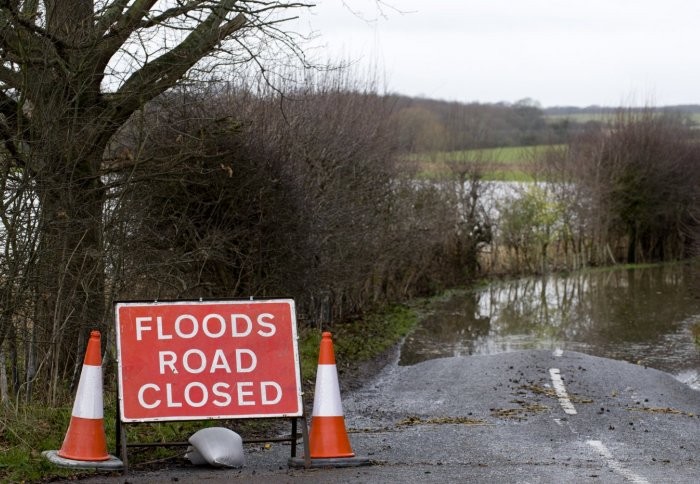
Models developed by Imperial researchers could help to predict floods.
Predicting floods, droughts and contamination in UK will be easier, thanks to models developed at Imperial. Predicting floods, droughts and contamination to the chalk aquifer, which provides up to 20 percent of the UK's water supply, will be easier, thanks to models developed by researchers from Imperial College London. The models could help provide communities with advanced warning of approaching groundwater flooding, Imperial academics teamed up with hydrogeologists and modellers from the British Geological Survey (BGS) to develop a range of models including one that more accurately predicts the time and location of groundwater flooding in southern England, which is the main location of the chalk aquifer. Nearly 400,000 properties stand at risk from groundwater flooding in areas such as the Berkshire & Hampshire Downs, the Isle of Wight, and the North and South Downs. Dr Adrian Butler, Reader in Subsurface Hydrology in the Department of Civil and Environmental Engineering at Imperial, says: "Despite 2012 starting out as a period of extreme drought, it ended as the wettest year on record for England. Now in 2013, if England should get a wetter than normal period, there is a distinct possibility for groundwater flooding to occur in areas dominated by the chalk aquifer. Though there is little than can be done to prevent these floods, our risk assessment models are able to help the Environment Agency (EA) in providing communities with advanced warnings so that they can prepare." Dr Butler and his fellow researchers, in collaboration with Thames Water, are also developing models to assess the effect of drought on water availability in the Chalk aquifer.
TO READ THIS ARTICLE, CREATE YOUR ACCOUNT
And extend your reading, free of charge and with no commitment.