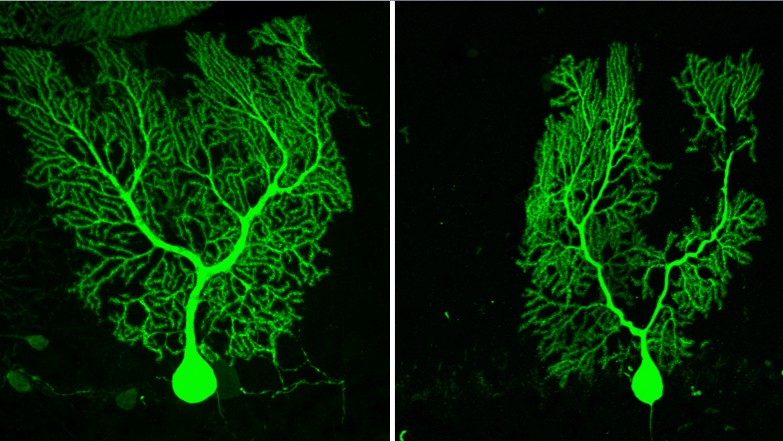
 Left: A healthy Purkinje cell displaying an elaborate dendritic arbor covered in spines.
Right: A Purkinje cell afflicted with Spinocerebellar ataxia type 1, showing classical hallmarks of
degeneration such as shrunken and reduced dendrite arbors and spines.
Left: A healthy Purkinje cell displaying an elaborate dendritic arbor covered in spines.
Right: A Purkinje cell afflicted with Spinocerebellar ataxia type 1, showing classical hallmarks of
degeneration such as shrunken and reduced dendrite arbors and spines.
Media releases, information for representatives of the media Media Relations (E) Scientists from Bern have discovered a mechanism which is responsible for the degeneration of Purkinje cells in the cerebellum in a neurodegenerative disease called Spinocerebellar ataxia type 1. The results of their study open up new avenues for the future treatment of cerebellum associated degenerative disorders. Damage, degeneration or loss of neurons in the region of the brain that controls muscle coordination (cerebellum), results in ataxia. The symptoms include loss of voluntary coordination of muscle movements and the appearance of gait abnormality, loss of balance and speech problems. Cerebellar ataxias are progressive degenerative disorders which occur in adults either sporadically or can be inherited from parents. Unfortunately, the large majority of cerebellar ataxia cases are sporadic in nature and the causative mechanism for the development of ataxia remains largely unknown, which eventually hinders the development of therapy and negatively influences the quality of patient's life. However, both the sporadic and inherited cases of cerebellar ataxia exhibit common pathophysiological characteristics such as the specific degeneration of the main cerebellar neurons; the Purkinje cells.
TO READ THIS ARTICLE, CREATE YOUR ACCOUNT
And extend your reading, free of charge and with no commitment.
Your Benefits
- Access to all content
- Receive newsmails for news and jobs
- Post ads