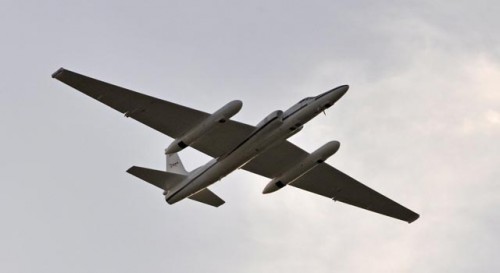
NASA’s ER-2 research aircraft, with JPL’s advanced AVIRIS instrument aboard, flew from California to Texas on May 6, 2010, for a series of flights to map the Gulf of Mexico oil spill and coastal areas.
An advanced JPL-built optical sensor flying aboard a NASA research aircraft is among several NASA remote-sensing assets being mobilized to help assess the spread and impact of the Deepwater Horizon BP oil spill in the Gulf of Mexico at the request of U.S. disaster response agencies. As part of the national response to the spill and at the request of the National Oceanic and Atmospheric Administration (NOAA), NASA deployed its instrumented research aircraft, the Earth Resources-2 (ER-2) to the Gulf on May 6. The ER-2, outfitted with JPL's Airborne Visible/Infrared Imaging Spectrometer (AVIRIS) and the Cirrus Digital Camera System, supplied by NASA's Ames Research Center, Moffett Field, Calif., was sent to collect detailed images of the Gulf of Mexico and its threatened coastal wetlands. NASA is also making extra satellite observations and conducting additional data processing to assist NOAA, the U.S. Geological Survey, and the Department of Homeland Security in monitoring the spill. "NASA has been asked to help with the first response to the spill, providing imagery and data that can detect the presence, extent and concentration of oil," said Michael Goodman, program manager for natural disasters in the Earth Science Division of NASA's Science Mission Directorate in Washington. "We also have longer-term work we have started in the basic research of oil in the ocean and its impacts on sensitive coastal ecosystems." NASA pilots flew the ER-2 from NASA's Dryden Flight Research Center in California to a temporary base of operations at Johnson Space Center's Ellington Field in Houston.
TO READ THIS ARTICLE, CREATE YOUR ACCOUNT
And extend your reading, free of charge and with no commitment.