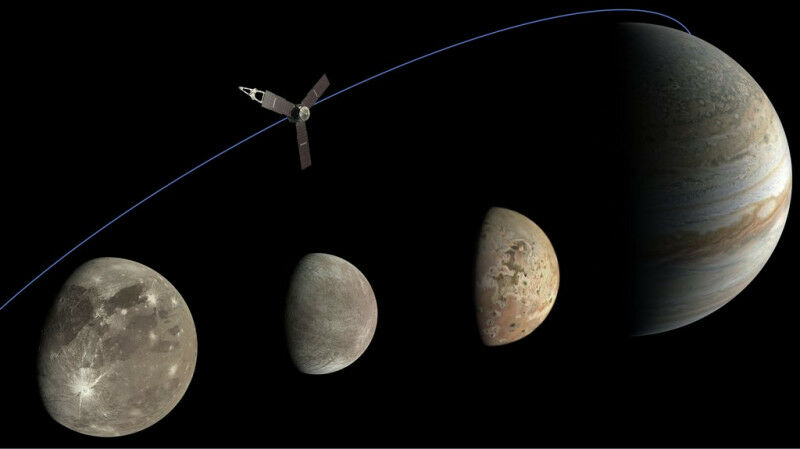
From left, Ganymede, Europa, and Io - the three Jovian moons that NASA’s Juno mission has flown past - as well as Jupiter are shown in a photo illustration created from data collected by the spacecraft’s JunoCam imager.
From left , Ganymede, Europa, and Io - the three Jovian moons that NASA's Juno mission has flown past - as well as Jupiter are shown in a photo illustration created from data collected by the spacecraft's JunoCam imager. The spinning, solar-powered spacecraft will take another look of the fiery Jovian moon on July 30. When NASA's Juno mission flies by Jupiter's fiery moon Io on Sunday, July 30, the spacecraft will be making its closest approach yet, coming within 13,700 miles (22,000 kilometers) of it. Data collected by the Italian-built JIRAM (Jovian InfraRed Auroral Mapper) and other science instruments is expected to provide a wealth of information on the hundreds of erupting volcanoes pouring out molten lava and sulfurous gases all over the volcano-festooned moon. "While JIRAM was designed to look at Jupiter's polar aurora, its capability to identify heat sources is proving to be indispensable in our hunt for active volcanos on Io," said Juno Principal Investigator Scott Bolton of the Southwest Research Institute in San Antonio. "As we get closer with each flyby, JIRAM and other instruments aboard Juno add to our library of data on the moon, allowing us to not only better resolve surface features but understand how they change over time." Credit: Galileo: NASA/JPL/University of Arizona. New Horizons: NASA/JHUAPL/SWRI.
TO READ THIS ARTICLE, CREATE YOUR ACCOUNT
And extend your reading, free of charge and with no commitment.