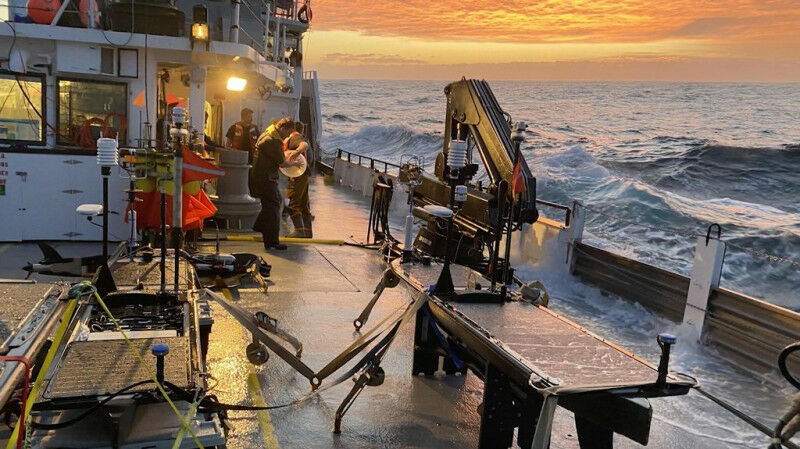
Autonomous wave gliders are seen being prepared for deployment on the deck of the research vessel Oceanus during the pilot campaign for NASA’s Sub-Mesoscale Ocean Dynamics Experiment (S-MODE) in the Pacific Ocean off the U.S. West Coast.
Autonomous wave gliders are seen being prepared for deployment on the deck of the research vessel Oceanus during the pilot campaign for NASA's Sub-Mesoscale Ocean Dynamics Experiment (S-MODE) in the Pacific Ocean off the U.S. West Coast. Editor's note: A composite image of a Twin Otter International plane carrying the Modular Aerial Sensing System was added on Oct. The mission's fleet of ship, aircraft, and marine robotics will study ocean eddies and other elusive features near the surface that have a big influence on climate. When the research vessel Bold Horizon sailed from Newport, Oregon, in early October, it joined a small armada of planes, drones, and other high-tech craft chasing the ocean's shapeshifting physics. NASA's Sub-Mesoscale Ocean Dynamics Experiment ( S-MODE ) is converging on a patch of sea 110 nautical miles off the coast of San Francisco. Over the course of 28 days, the team will deploy a new generation of tools to observe whirlpools, currents, and other dynamics at the air-sea boundary. The goal: to understand how these dynamics drive the give-and-take of nutrients and energy between the ocean and atmosphere and, ultimately, help shape Earth's climate.
TO READ THIS ARTICLE, CREATE YOUR ACCOUNT
And extend your reading, free of charge and with no commitment.