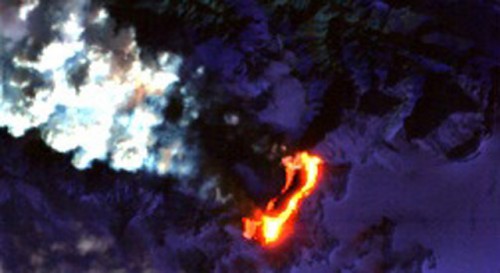
False-color short-wavelength infrared image of Iceland’s Eyjafjallajokull volcano from data obtained by NASA’s EO-1 Hyperion satellite on March 24, 2010. Image credit: NASA/JPL/EO-1 Mission/GSFC/Ashley Davies
A NASA research team is using the latest advances in satellite artificial intelligence to speed up estimates of the heat and volume of lava escaping from an erupting volcano in Iceland. On March 20, 2010, Iceland's Eyjafjallajökull volcano (pronounced "Aya-fyatla-jo-kutl,") awakened for the first time in 120 years, spewing still-active lava fountains and flows. That day, a NASA "sensor web" - a network of sensors on the ground and aboard NASA's Earth Observing-1 satellite, alerted researchers to this new volcanic "hot spot." The eruption was detected by autonomous "sciencecraft" software aboard the satellite, which is known as EO-1. Sciencecraft software enables the spacecraft to analyze science data onboard to detect scientific events and respond by sending alerts, producing scientific products and/or re-imaging the event. The software is typically able to notify researchers on the ground within 90 minutes of detecting events, and then rapidly sets up the satellite to observe them. In the case of the Iceland volcanic event, EO-1 was able to take advantage of recently uploaded "smart" software that allows the spacecraft to react quickly to an event and to rapidly downlink the data for processing by ground personnel in less than 24 hours. That process used to take three weeks for researchers working manually.
TO READ THIS ARTICLE, CREATE YOUR ACCOUNT
And extend your reading, free of charge and with no commitment.