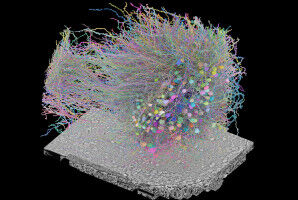
Neural Mapping Paints A Haphazard Picture of Odor Receptors
Cambridge, Mass. February 3, 2009 - Despite the striking aromatic differences between coffee, peppermint, and pine, a new mapping of the nose's neural circuitry suggests a haphazard patchwork where the receptors for such disparate scents are as likely as not to be neighbors. Inexplicably, this seemingly random arrangement is faithfully preserved across individuals and even species, with cells that process the same scent located in precisely the same location on the olfactory bulb, the brain's first processing station for odors. "It had been thought that the layout of the olfactory bulb was variable from individual to individual, but followed a chemotopic order where cells handling similar odor responses are near each other," says Markus Meister, the Jeff C. Tarr Professor of Molecular and Cellular Biology in Harvard's Faculty of Arts and Sciences. "Here we show that the layout is actually very precise - the same from animal to animal - but doesn't appear to follow any chemotopic order whatsoever." Working with mice and rats, Meister and colleague Venkatesh N. Murthy recorded neural responses to several hundred distinct odors, including anise, beer, cloves, coffee, ginger, lemon, orange, peppermint, pine, rose, and even fox pheromones. The neuroscientists found that across individuals and even across the two species, bundles of neurons from a given type of odor receptor - known as glomeruli - were found in almost exactly the same spot on the olfactory bulb, a sensory structure measuring some four to five millimeters across and located at the very front of the brain.