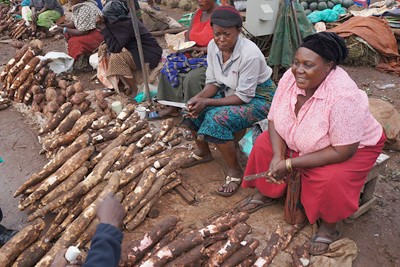
In Africa, cassava is typically considered a "woman’s crop" - primarily grown, processed and sold by women. Here, it is being sold in a market in Kampala, Uganda.
To improve the productivity of cassava - a rough and ready root crop that has long been the foundation of food security in Africa - and plant breeding in sub-Saharan Africa, the Bill & Melinda Gates Foundation and the Department for International Development of the United Kingdom have awarded Cornell $25.2 million to host a five-year research project. Cornell will coordinate work with the National Crops Resources Research Institute (NaCRRI) in Uganda, National Root Crops Research Institute (NRCRI) in Nigeria, International Institute of Tropical Agriculture (IITA) in Nigeria, Boyce Thompson Institute for Plant Research (BTI) on the Cornell campus, and the U.S. Department of Energy Joint Genome Institute at the Lawrence Berkeley National Laboratory in California. "Partners on the Next Generation Cassava Breeding project will use a state-of-the-art plant breeding approach, known as genomic selection, to improve cassava productivity for the 21st century," said Ronnie Coffman, Cornell professor of plant breeding and genetics, director of International Programs and the grant's principal investigator. Typically, it takes researchers almost a decade to develop a new cassava variety. Genomic selection can shorten breeding cycles, provide more accurate evaluation at the seedling stage and give plant breeders the ability to evaluate a much larger number of clones without the need to plant them in the target environment. Using genomic selection, new releases of cassava could be ready in as little as six years.
TO READ THIS ARTICLE, CREATE YOUR ACCOUNT
And extend your reading, free of charge and with no commitment.