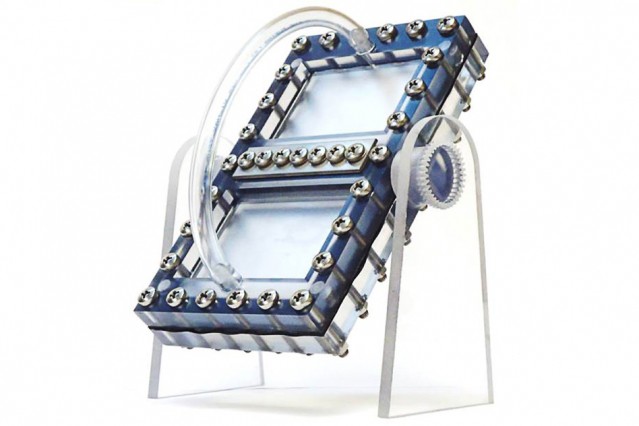
A new concept for a flow battery functions like an old hourglass or egg timer, with particles (in this case carried as a slurry) flowing through a narrow opening from one tank to another. The flow can then be reversed by turning the device over.
A new approach to the design of a liquid battery, using a passive, gravity-fed arrangement similar to an old-fashioned hourglass, could offer great advantages due to the system's low cost and the simplicity of its design and operation, says a team of MIT researchers who have made a demonstration version of the new battery. Liquid flow batteries - in which the positive and negative electrodes are each in liquid form and separated by a membrane - are not a new concept, and some members of this research team unveiled an earlier concept three years ago. The basic technology can use a variety of chemical formulations, including the same chemical compounds found in today's lithium-ion batteries. In this case, key components are not solid slabs that remain in place for the life of the battery, but rather tiny particles that can be carried along in a liquid slurry. Increasing storage capacity simply requires bigger tanks to hold the slurry. But all previous versions of liquid batteries have relied on complex systems of tanks, valves, and pumps, adding to the cost and providing multiple opportunities for possible leaks and failures. The new version, which substitutes a simple gravity feed for the pump system, eliminates that complexity.
TO READ THIS ARTICLE, CREATE YOUR ACCOUNT
And extend your reading, free of charge and with no commitment.