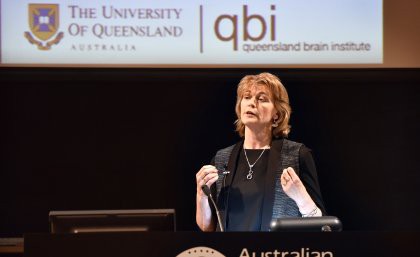
Naomi Wray
Researchers at The University of Queensland have contributed to the discovery of three new genes which increase the risk of motor neurone disease (MND), opening the door for targeted treatments. Professor Naomi Wray from UQ's Queensland Brain Institute was involved in the data analysis as a part of an international study of more than 30,000 people. "These three new genes open new opportunities for research to understand a complex and debilitating disease which currently has no effective treatments," Professor Wray said. "Crucially, we hope Australian patients will be included in the next phase of the study, thanks to funds raised by the Ice Bucket Challenge." "We're very hopeful that in the next phase of discovery, as sample sizes with measured DNA increase, that we'll discover more genes associated with MND." More than 1400 Australians have MND (also known as ALS). Nerve cells controlling the muscles that enable us to move, speak, breathe and swallow begin to degenerate and die, and the average life expectancy is two to three years. For more than 90 per cent of patients the diagnosis comes out of the blue - in what's known as sporadic MND. This latest research has increased the number of genes associated with the sporadic form of motor neurone disease from one to four.
TO READ THIS ARTICLE, CREATE YOUR ACCOUNT
And extend your reading, free of charge and with no commitment.