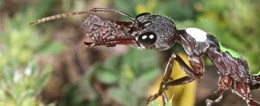
Photo by Ajay Narendra.
Researchers studying the eyes of Australian bull ants have found the first evidence of adaptation of visual structures within a single species to distinct light intensities. The research, led by Dr Ajay Narendra of the Division of Evolution, Ecology and Genetics at The Australian National University, found that the eye structure of the bull ants genus Myrmecia changed according to their role in the colony. Ants which were required to work at night and walk were equipped with night vision, while ants whose role required day work or had to fly had a different eye structure. 'Our research shows that the time of day insects are active and the task they carry out influences eye design,' said Dr Narendra. ?We discovered that in certain species worker activity times and flight times of winged forms do not match. In all cases, individuals active at night were equipped with night-vision equipment: more and larger facets and wider rhabdoms (photosensitive structure in the eyes of most arthropods), compared to the day-active individuals.' Dr Narendra said the ants? caste system lent itself to studying differences. ?To identify if tasks carried out by individuals influences eye design, we took advantage of the unique caste system of ants.
TO READ THIS ARTICLE, CREATE YOUR ACCOUNT
And extend your reading, free of charge and with no commitment.