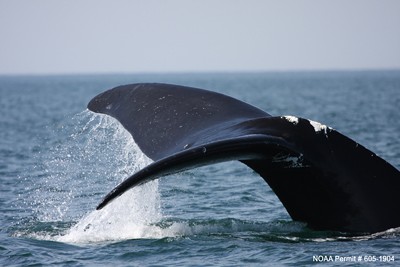
North Atlantic right whale.
High levels of background noise, mainly due to ships, have reduced the ability of critically endangered North Atlantic right whales to communicate with each other at the mouth of the Massachusetts Bay by about two-thirds, according to a new study published in the August issue of the journal Conservation Biology (26:4). From 2007 until 2010, scientists from the Stellwagen Bank National Marine Sanctuary, Cornell Lab of Ornithology, National Oceanic and Atmospheric Administration (NOAA) Northeast Fisheries Science Center and Marine Acoustics Inc. used an array of acoustic recorders to monitor noise levels and measure levels of sound associated with vessels, and to record distinctive sounds made by multiple species of endangered baleen whales, including "up-calls" made by right whales to maintain with each other. The Northeast Fisheries Science Center documented more than 22,000 right whale calls as part of the study in April 2008, and software developed by Cornell and Marine Acoustics aided in modeling ship noise propagation throughout the study area. Vessel-tracking data from the U.S. Coast Guard's Automatic Identification System was used to calculate noise from vessels inside and outside the sanctuary. By further comparing noise levels from commercial ships today with historically lower noise conditions nearly a half-century ago, the authors estimate that right whales have lost, on average, 63-67 percent of their communication space in the sanctuary and surrounding waters.
TO READ THIS ARTICLE, CREATE YOUR ACCOUNT
And extend your reading, free of charge and with no commitment.