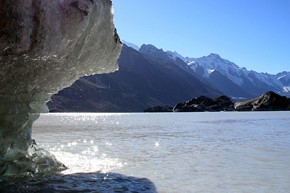
Tasman glacial melt. Photo by EmmaJG
The influence of the world's oceans over carbon dioxide levels and climate change is better understood thanks to researchers from the University of Canberra and The Australian National University. The scientists - Dr Michael Ellwood from the ANU Research School of Earth Sciences in the College of Physical and Mathematical Sciences and Professor Bill Maher, Head of the EcoChemistry Laboratory, University of Canberra - have developed techniques to test what nutrient levels marine plants need to survive. The research, which studied nutrient levels back to the last Ice Age and beyond, sheds new light on the impact of carbon dioxide on the planet. The researchers say that with carbon dioxide levels predicted to rise due to the continued burning of fossil fuels it is essential to understand what stimulates the growth of marine algae. 'Our study revealed that marine plants help to control the level of carbon dioxide released in the atmosphere,' said Dr Ellwood. 'Understanding the distributions of key nutrients such as phosphate, nitrate and silicate in the surface and deep-ocean is essential to understand the method by which marine plants influenced the drawdown of atmospheric carbon dioxide in the past,' he added. Through their research Dr Ellwood and Professor Maher have been able to monitor changes in ocean nutrient levels back to the last ice age and beyond.
TO READ THIS ARTICLE, CREATE YOUR ACCOUNT
And extend your reading, free of charge and with no commitment.