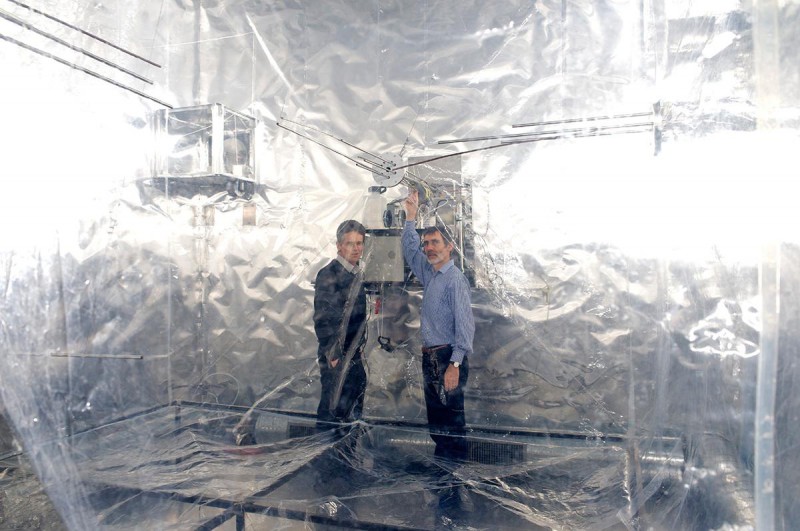
Smog chamber of the PSI with researchers.
Frank Reiser/Paul Scherrer Institut
Particulate matter from gasoline engines is harmful to our airways, regardless of whether the engines are a bit older or comply with recent EU standards. Fine dust particles allow pathogens to enter the lungs easier. Researchers at the University of Bern and the Paul Scherrer Institute PSI have shown this conducting a realistic laboratory experiment. According to the latest report from the World Health Organization (WHO), 7 million worldwide died early of the consequences of air pollution in 2012. Studies have shown for more than a decade that particulate matter (PM) in the air adversly affects health. Besides primary particles, i.e. those emitted directly by the source, secondary particles, which are photochemically produced altered by sunlight, are of crucial importance: They are ubiquitous and can make up to 90 percent of the total particulate matter. One important source of particulate matter are emissions from gasoline engines and it has only recently been discovered that these produce significant amounts of secondary particulate matter.
TO READ THIS ARTICLE, CREATE YOUR ACCOUNT
And extend your reading, free of charge and with no commitment.