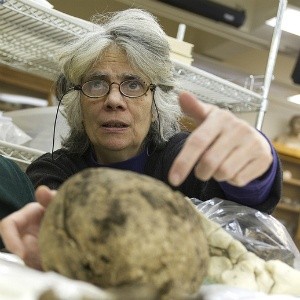
Janet Monge
Atherosclerosis, or hardening of the arteries, has been widely assumed to be a disease of modern times, brought on by modern foods and lifestyles - until now. A recent study of 137 mummies from four regions of the world - including five Ancestral Puebloan mummies from the American Southwest, circa 1500 B.C.E. to 1500 C.E., in the University of Pennsylvania Museum of Archaeology and Anthropology collection - revealed clear or probable signs of atherosclerosis in 34 percent of the international group, dated from about 4,000 to 110 years old, with individuals who died between the ages of 2 and 60. The surprising prevalence of the disease among such a large percentage of pre-modern humans raises the distinct possibility that people have long had a more basic predisposition to the life-threatening disease. Such was the conclusion reached by a group of scientists, presenting their paper in the March 10 online edition of the medical journal The Lancet. Janet Monge , associate curator in the Penn Museum's Physical Anthropology Section , and Samantha L. Cox a former Penn undergraduate student, were coauthors on the study, which was led by Randall C. Thompson of Saint Luke's Mid America Heart Institute and the University of Missouri-Kansas City School of Medicine. Of the five Penn Museum mummies in the study, one was probable and one was deemed definite for the disease.
TO READ THIS ARTICLE, CREATE YOUR ACCOUNT
And extend your reading, free of charge and with no commitment.