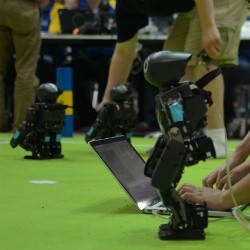
Computer-assisted programming could make the make the coding responsible for robotic behaviors less tedious and more intuitive.
The University of Pennsylvania will lead a $10 Million National Science Foundation project to make computer programming faster, easier and more intuitive. Dubbed ExCAPE for Expeditions in Computer Augmented Program Engineering, the project is a highly collaborative effort that will involve multiple research institutions, partners in industry and educational outreach to the next generation of computer scientists. The project was awarded a five-year, $10 million grant as part of the NSF's Expeditions in Computing program, which funds teams with ambitious, fundamental-research agendas in computer science. The ExCAPE team will be led by Rajeev Alur , professor of computer and information science in Penn's School of Engineering and Applied Science. Alur will collaborate with fellow Penn engineering professors Milo Martin , Boon Thau Loo , George Pappas and Steve Zdancewic. The ExCAPE team also includes researchers from the University of California, Berkeley; the University of California, Los Angeles; Cornell University; the University of Illinois at Urbana-Champaign; the University of Maryland; the Massachusetts Institute of Technology; the University of Michigan; and Rice University. "Computers have evolved at a dramatic pace, but the technology that's used to develop programs and software is evolving comparatively slowly," Alur said.
TO READ THIS ARTICLE, CREATE YOUR ACCOUNT
And extend your reading, free of charge and with no commitment.