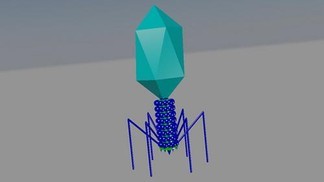
Phage Pierces the Host Cell Membrane with the Iron-Loaded Spike. Bacteriophages with contractile tails and the bacterial type VI secretion system have been proposed to use a special protein to create an opening in the host cell membrane during infection. These proteins have a modular architecture but invariably contain an oligonucleotide/oligosaccharide-binding (OB-fold) domain and a long β-helical C-terminal domain, which initiates the with the host cell membrane. Using X-ray crystallography and electron microscopy, the group of Petr Leiman (Laboratory of Structural Biology and Biophysics) report the atomic structure of the membrane-piercing proteins from bacteriophages P2 and 92 and identify the residues that constitute the membrane-attacking apex. Both proteins form compact spikes with a ∼10Å diameter tip that is stabilized by a centrally positioned iron ion bound by six histidine residues. The accumulated data strongly suggest that, in the process of membrane penetration, the spikes are translocated through the lipid bilayer without undergoing major unfolding. Christopher Browning et al.
TO READ THIS ARTICLE, CREATE YOUR ACCOUNT
And extend your reading, free of charge and with no commitment.
Your Benefits
- Access to all content
- Receive newsmails for news and jobs
- Post ads