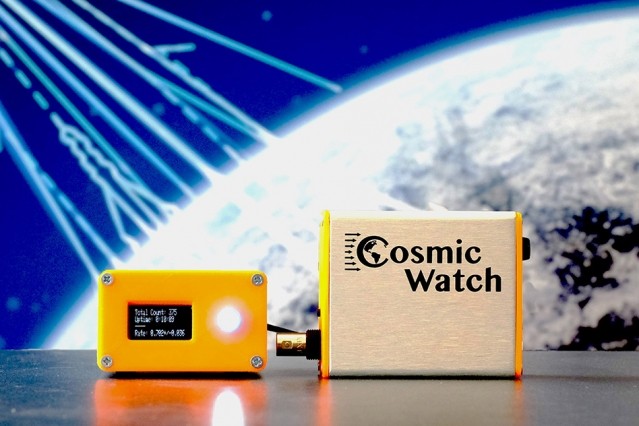
Physicists at MIT have designed a pocket-sized cosmic ray muon detector to track these ghostly particles.
At any given moment, the Earth's atmosphere is showered with high-energy cosmic rays that have been blasted from supernovae and other astrophysical phenomena far beyond the Solar System. When cosmic rays collide with the Earth's atmosphere, they decay into muons - charged particles that are slightly heavier than an electron. Muons last only fractions of a second, and during their fleeting lifespan they can be found through every layer of the Earth's atmosphere, circulating in the air around us and raining onto the surface at a rate similar to a light drizzle. A small fraction of muons can even penetrate the Earth's surface and travel several kilometers through rock and ice. Now physicists at MIT have designed a pocket-sized cosmic ray muon detector to track these ghostly particles. The detector can be made with common electrical parts, and when turned on, it lights up and counts each time a muon passes through. The relatively simple device costs just $100 to build, making it the most affordable muon detector available today.
TO READ THIS ARTICLE, CREATE YOUR ACCOUNT
And extend your reading, free of charge and with no commitment.