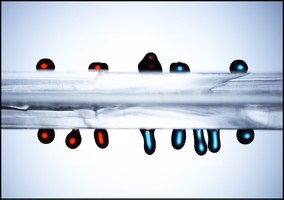
Karl Bohringer, UW Drops of red and blue liquid move along the upper and lower surface of the vibrating UW platform at speeds up to 1 inch per second. This combined image shows drops as they move toward the center and merge.
As medical researchers and engineers try to shrink diagnostics to fit in a person's pocket, one question is how to easily move and mix small samples of liquid.
"This allows us to move drops as far as we want, and in any kind of layout that we want," said Karl Böhringer , a UW professor of electrical engineering and bioengineering. The low-cost system, published in a recent issue of the journal Advanced Materials , would require very little energy and avoids possible contamination by diluting or electrifying the samples in order to move them. The simple technology is a textured surface that tends to push drops along a given path. It's inspired by the lotus effect - a phenomenon in which a lotus leaf's almost fractal texture makes it appear to repel drops of water.
- "The lotus leaf has a very rough surface, in which each big bump has a smaller bump on it," Böhringer said. "We can't make our surface exactly the same as a lotus leaf, but what we did is extract the essence of why it works." -
Researchers used an audio speaker or machine to vibrate the platform at 50 to 80 times per second.
TO READ THIS ARTICLE, CREATE YOUR ACCOUNT
And extend your reading, free of charge and with no commitment.