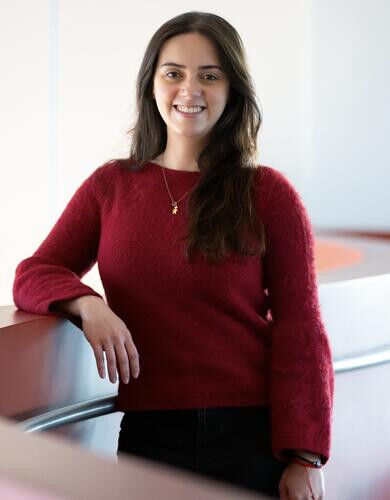
One Child Every Child trainee awards support a new generation of child health and wellness researchers, such as Rachel De Barros Oliveira
Postdoctoral researcher Dr. Rachel De Barros Oliveira, PhD, is a neuroscientist with a love for genetics.
While a doctoral candidate at McGill University and working at a podcast called Curious Neuron , she booked Dr. Nicole Letourneau, PhD , as a guest for an episode. Letourneau is a University of Calgary researcher and co-founder of ATTACH (TM) - a parenting program designed to support stressed parents build secure attachment with their children, leading to healthy child development.
Inspired by the conversation and Letourneau’s studies, De Barros Oliveira, who was a graduate student at the time, felt a strong connection to the work.
"I told her, ’Your program is exactly what people need.’ I was very interested in collaborating," she says.
Following the interview, the two began discussing potential research directions. De Barros Oliveira then applied for and was accepted into a postdoctoral position in Letourneau’s lab at UCalgary, receiving funding through the One Child Every Child training accelerator and Alberta Innovates Postdoctoral Fellowships.
"We already know that the ATTACH(TM) program works," says De Barros Oliveira. "My research focuses on understanding why it works, what biological and brain-based changes occur when caregivers receive the ATTACH(TM) program’s training. "Are there changes in the brain or DNA methylation patterns? That’s what we want to explore."
As a postdoctoral researcher, she plays a key role in coordinating multiple components of the study. Her responsibilities include organizing the collection of blood and saliva samples from participants, scheduling MRI sessions, and analyzing complex datasets. She also contributes to scientific publications and helps translate the study’s findings into accessible knowledge for families and professionals. Additionally, she is also being trained as an ATTACH(TM) facilitator, allowing her to directly support caregivers participating in the program.
"My team and I are absolutely delighted to have recruited such an outstanding new scholar to our lab," says Letourneau, a professor in the Faculty of Nursing and at the Cumming School of Medicine.
"Her excellent neuroscience training, combined with her energy and enthusiasm, will propel our work forward to uncover the mechanisms to explain ATTACH(TM) positive impacts. Trainees like Dr. De Barros Oliveira are a tremendous asset to the University of Calgary."
Parenting program
The ATTACH(TM) program is an evidence-based parenting program that helps parents learn mentalization and reflective function skills. These skills help them understand and reflect on both their own and their child’s thoughts, feelings, and needs which lead to secure attachment and support healthy child development.
"It’s amazing, one simple program can have a huge impact on people’s lives. I’m excited to see the changes on a biological level," says De Barros Oliveira. "It’s an easy-to-deliver program that can be provided anywhere in the world and is adaptable to other cultures. It’s a tool that can really improve parent-child interactions."
The program is delivered for no cost by many Calgary community partners, including CUPS and the Mustard Seed. The program is being delivered internationally in Brazil, Denmark and France.