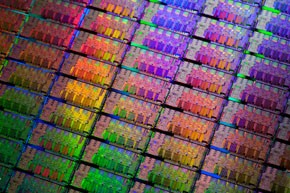
One of Intel's second-generation core processors. Photo courtesy of Intel.
New and better ways of measuring high-tech energy consumption could lead to significant environmental and economic gains, a study from The Australian National University has found. Researchers from ANU, the University of Texas at Austin and the University of Washington have completed the first systematic profile of microprocessors - the integrated computer chips that act as a central processing unit in electronic devices like smart phones, computers and giant data centres. Steve Blackburn from the ANU College of Engineering and Computer Science, who led the study with Professor Kathryn McKinley from the University of Texas at Austin and their students, said that the findings could help lower the energy costs of electronic devices ranging from small mobile devices, supercomputers to massive server farms. "We looked at the power profiles of different software and different chip architectures, as well as application power, performance and energy on a wide variety of hardware. These were measurements that no one had ever looked at before. We found that different software have really different power usages. This is really important because as technology and processors are getting smaller and smaller it has stopped yielding exponential gains in power and performance.
TO READ THIS ARTICLE, CREATE YOUR ACCOUNT
And extend your reading, free of charge and with no commitment.