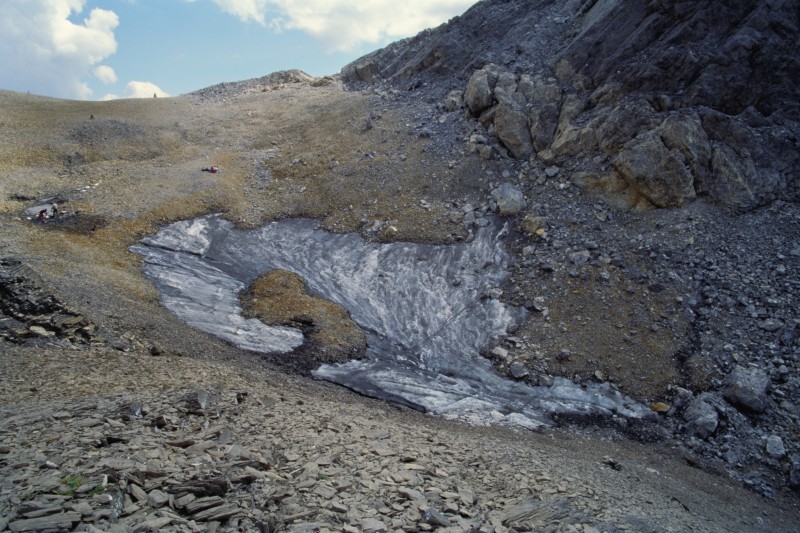
The ice field on the Schnidejoch Pass (2,756 metres above sea level) has melted dramatically in the last few decades. The picture shows the situation in 2005. (Image: Kathrin Glauser)
Media releases, information for representatives of the media Media Relations (E) The people in Switzerland were on the move in the High Alps and running alpine pastures 7,000 years ago and therefore much earlier than previously assumed. A study by the University of Bern that combines archaeological knowledge with findings from palaeoecology comes to this conclusion. Prehistoric finds from the Schnidejoch Pass played a crucial part in this. Did shepherds actually drive their herds from Lower Valais to the Bernese Oberland and graze their sheep there around 5,000 BC? Many factors indicate that this theory, which would have just been dismissed as speculation until recently, reflects reality. "We have strong indications that argue that people were on the move in the mountains with their animals much earlier than previously assumed", says Albert Hafner, Professor of Prehistoric Archaeology at University of Bern. Albert Hafner and Christoph Schwörer, environmental scientist and specialist in vegetation history at the Institute of Plant Sciences at University of Bern, have just provided the chain of evidence that supports this assumption in an article in the "Quaternary International" specialist journal. Both scientists are members of the Oeschger Centre for Climate Change Research at University of Bern "The combination of two approaches', explains Albert Hafner, "allowed us to collect better data and also interpret it with a new perspective.
TO READ THIS ARTICLE, CREATE YOUR ACCOUNT
And extend your reading, free of charge and with no commitment.