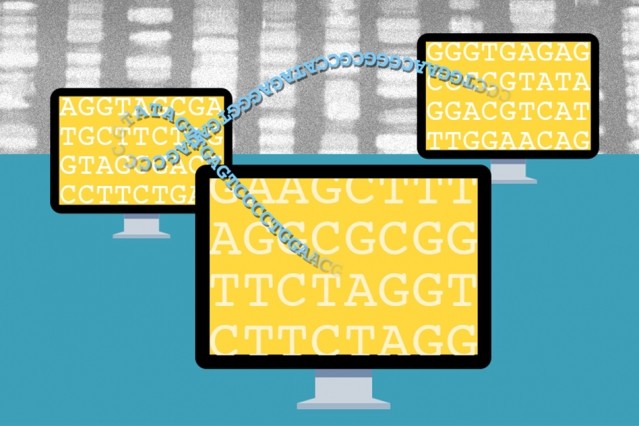
Cleverly dividing information among multiple servers lets an MIT system protects the privacy of contributors to genomic databases in a way that is much more computationally efficient than standard cryptographic techniques.
Genome-wide association studies, which look for links between particular genetic variants and incidence of disease, are the basis of much modern biomedical research. But databases of genomic information pose privacy risks. From people's raw genomic data, it may be possible to infer their surnames and perhaps even the shapes of their faces. Many people are reluctant to contribute their genomic data to biomedical research projects, and an organization hosting a large repository of genomic data might conduct a months-long review before deciding whether to grant a researcher's request for access. In a paper appearing today , researchers from MIT and Stanford University present a new system for protecting the privacy of people who contribute their genomic data to large-scale biomedical studies. Where earlier cryptographic methods were so computationally intensive that they became prohibitively time consuming for more than a few thousand genomes, the new system promises efficient privacy protection for studies conducted over as many as a million genomes. "As biomedical researchers, we're frustrated by the lack of data and by the access-controlled repositories," says Bonnie Berger, the Simons Professor of Mathematics at MIT and corresponding author on the paper.
TO READ THIS ARTICLE, CREATE YOUR ACCOUNT
And extend your reading, free of charge and with no commitment.