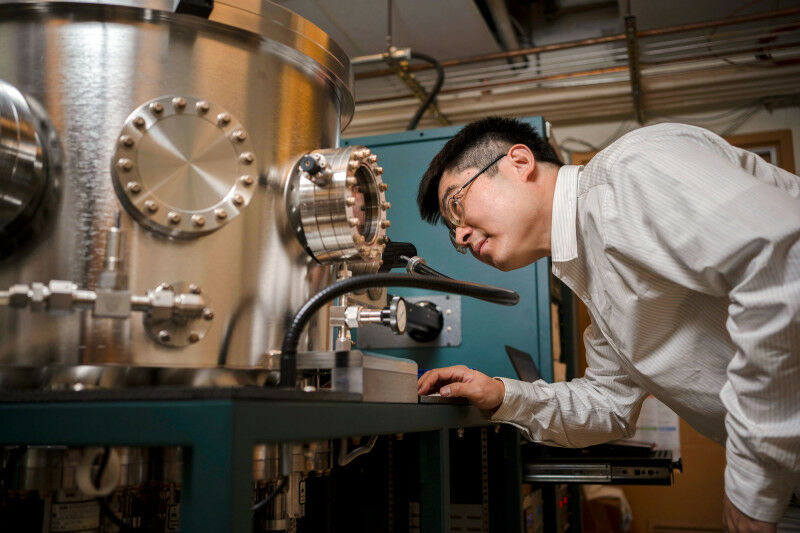
MIT Associate Professor Luqiao Liu utilizes novel materials and electron spin to create next-generation memory hardware for computers that can store more information, use less power to operate, and retain information for a longer period of time. In this photo, Liu peers inside a sputtering deposition system, which is used to grow magnetic thin films. Credits : Photo: Jodi Hilton
MIT Associate Professor Luqiao Liu utilizes novel materials and electron spin to create next-generation memory hardware for computers that can store more information, use less power to operate, and retain information for a longer period of time. In this photo, Liu peers inside a sputtering deposition system, which is used to grow magnetic thin films. Credits : Photo: Jodi Hilton - Luqiao Liu utilizes a quantum property known as electron spin to build low-power, high-performance computer memories and programmable computer chips. Luqiao Liu was the kind of kid who would rather take his toys apart to see how they worked than play with them the way they were intended. Curiosity has been a driving force throughout his life, and it led him to MIT, where Liu is a newly tenured associate professor in the Department of Electrical Engineering and Computer Science and a member of the Research Laboratory of Electronics. Rather than taking things apart, he's now using novel materials and nanoscale fabrication techniques to build next-generation electronics that use dramatically less power than conventional devices. Curiosity still comes in handy, he says, especially since he and his collaborators work in the largely uncharted territory of spin electronics - a field that only emerged in the 1980s.
TO READ THIS ARTICLE, CREATE YOUR ACCOUNT
And extend your reading, free of charge and with no commitment.