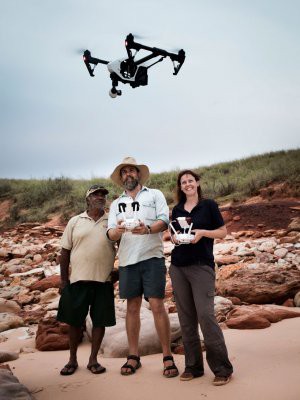
Goolarabooloo Law Boss Phillip Roe, Dr Steve Salisbury and Linda Pollard use the dino-drone. Photo: Damian Kelly.
University of Queensland palaeontologists are using the latest scientific technology to capture new information that will help bring a 130-million-year-old dinosaur landscape back to life. School of Biological Sciences Senior Lecturer Dr Steve Salisbury and his team have returned from a dinosaur hunt along the 'Dinosaur Coast' in the remote Kimberley region of Western Australia. Palaeontologist and dinosaur track expert Dr Anthony Romilio said the team was documenting fossilised dinosaur tracks in an effort to learn more about what sorts of dinosaurs inhabited Australia 130 million years ago. "The sandstone that the tracks occur in crops out in the intertidal zone, at sites scattered along roughly 100 km of coastline," he said. "Because of the extreme tides in this part of Australia, the rock platforms we're working on are exposed for only a short window each day, and sometimes for only a few days each year. "This means we have to work very quickly, before the tracks go underwater. "We take physical moulds of tracks using a rapid-setting silicon rubber which can then be used to produce rigid plastic replicas back at UQ.
TO READ THIS ARTICLE, CREATE YOUR ACCOUNT
And extend your reading, free of charge and with no commitment.