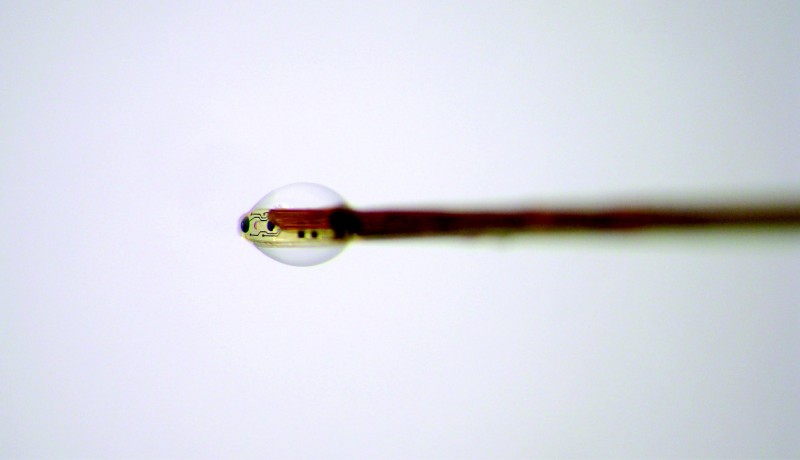
 © Guillaume Petit-Pierre - Perfusion microdroplet allowing the extraction of interstitial liquid using the system developed by EPFL researchers.
Researchers at EPFL have developed a new device and analysis method that let doctors measure the neurochemicals in a patient's brain. The Microsystems Laboratory 4 (LMIS4)'s system involves collecting microdroplets of cerebral fluid and analyzing them to obtain chemical data that can help doctors diagnose and treat neurodegenerative diseases. Neurologists often use electrical impulses to stimulate and read brain signals. But the chemicals that neurons produce in response to these impulses are poorly understand at this point, even though they can provide valuable information for understanding the mechanisms behind neurodegenerative diseases like Alzheimer's and Parkinson's. "Neurons can be read two ways: electrically or chemically," says Guillaume Petit-Pierre, a post-doc researcher at LMIS4 and one of the study's authors. "Reading their electrical behavior can provide some limited information, such as the frequency and pace at which neurons communicate. However, reading their neurochemistry gives insight into the proteins, ions and neurotransmitters in a patient's cerebral fluid." By analyzing this fluid, doctors can obtain additional information - beyond that provided by neurons - and get a complete picture of a patient's brain tissue metabolism.
TO READ THIS ARTICLE, CREATE YOUR ACCOUNT
And extend your reading, free of charge and with no commitment.
Your Benefits
- Access to all content
- Receive newsmails for news and jobs
- Post ads