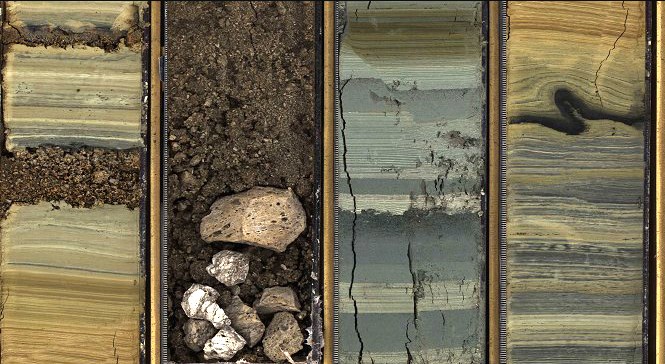
 Each 20-centimetre core section reflects up to 400 years of Lake Van’s history. The fine, brown-beige layers are typical seasonally laminated sediments.
Media releases, information for representatives of the media Media Relations (E) The sediments of Lake Van in Eastern Anatolia (Turkey) are a valuable climate archive. Now, using the salinity measured in sediment porewater, scientists from the University of Bern and other institutions have reconstructed the huge lake-level fluctuations that occurred over the past 250,000 years. This approach - based on simple physical concepts - is likely to be more widely applied in the future. In 2010, an international research team collected sediment cores from the bottom of Lake Van in Eastern Anatolia. Since then, scientists at Eawag and the Universities of Bern, Bonn and Istanbul have used core samples to reconstruct 600,000 years of climatic and environmental history. The sediments of Lake Van - a waterbody seven times the size of Lake Constance, with no outflows and remaining ice'free even during ice ages - provide a record not only of seasonal changes but also of volcanic eruptions, earthquakes, and extended glacial and interglacial (warm) periods, as well as other environmental data. Lake Van is the world's largest soda lake.
TO READ THIS ARTICLE, CREATE YOUR ACCOUNT
And extend your reading, free of charge and with no commitment.
Your Benefits
- Access to all content
- Receive newsmails for news and jobs
- Post ads


