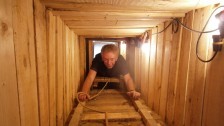
Hugh in the recreated tunnel at Zagan Credit: Hugh Hunt, Department of Engineering
First it was the Dambusters raid, now Cambridge University's Hugh Hunt has helped to recreate 'The Great Escape' from Germany's infamous Stalag Luft III. What I think we learned from attempting to do something similar ourselves is the magnitude of the task; it's simply amazing what they achieved given how difficult it was." - —Hugh Hunt - Immortalised by the largely fictionalised 1963 Hollywood film starring Steve McQueen and Richard Attenborough, 'the great escape' of RAF airmen from the German PoW camp has become the stuff of legend. But how did 76 men escape via a 100m-long tunnel from a camp built on a site chosen especially to thwart an escape by such means? Hugh was among a team of experts, archaeologists, veterans and modern-day RAF personnel taken back to the site near Zagan in Poland to excavate for the first time the remains of 'George', a tunnel that was in progress when the war ended, and the famous 'Harry' tunnel from which the Allied airmen escaped on the moonless night of March 24, 1944. The results can be seen in 'Digging the Great Escape', shown on Channel 4 on Monday evening (November 28) at 9pm. The programme follows last year's successful attempt by Hunt to recreate 617 Squadron's Dambusters raid. Hugh, from Cambridge University's Engineering Department, said: "Although only a handful of men worked on the tunnel directly, the escape plan involved hundreds of prisoners who never really knew what the plan actually was. It was some people's job to move bin lids or wear their hat a certain way if a German guard was coming - but they never knew why.
TO READ THIS ARTICLE, CREATE YOUR ACCOUNT
And extend your reading, free of charge and with no commitment.