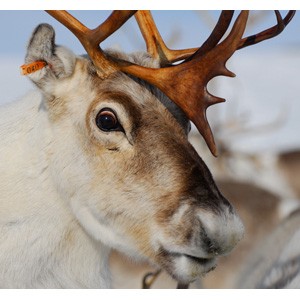
Arctic reindeer, by
Erling Nordøy
The eyes of Arctic reindeer change colour through the seasons from gold to blue, adapting to extreme changes of light levels in their environment and helping detect predators. The research, funded by the Biotechnology and Biological Sciences Research Council (BBSRC) and carried out by scientists at the UCL Institute of Opthalmology and the University of Tromsø, Norway, showed that the colour change helps reindeer to see better in the continuous daylight of summer and continuous darkness of Arctic winters, by changing the sensitivity of the retina to light. Arctic reindeer, like many animals, have a layer of tissue in the eye called the tapetum lucidum (TL) which lies behind the retina and reflects light back through it to enhance night vision. By changing its colour, the TL reflects different wavelengths of light. In the bright light of summer the TL in Arctic reindeer is gold, similar to many other mammals, which reflects most light back directly through the retina. However by winter it has changed to a deep blue which reflects less light out of the eye. This colour change in reindeers' eyes gives them an advantage when it comes to spotting predators in the low light of an Arctic winter.
TO READ THIS ARTICLE, CREATE YOUR ACCOUNT
And extend your reading, free of charge and with no commitment.