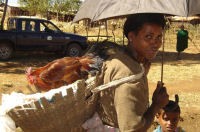
Poultry play an important role in the livelihoods of many rural communities in Ethiopia
Poultry play an important economic, nutritional and socio-cultural role in the livelihoods of poor rural households in many developing countries, including Ethiopia, where they are an integrated part of the smallholder production systems and play a significant role in alleviating poverty. Poultry production is particularly important to women, who tend to own and manage chickens. The resulting income is often used to support education of children. The study - a collaboration involving the International Institute for Livestock Research in Addis Ababa, the Ethiopian Institute for Agricultural Research, the University of Nottingham and the Roslin Institute - aims to identify the causes of infectious diseases which have a major impact on poultry production in Ethiopia. This will be linked with an ongoing poultry breeding programme in the country to improve resistance to these priority infectious diseases whilst enhancing productivity. Dr Rob Christley, Head of Epidemiology and Public Health and Co-Director of the National Centre for Zoonosis Research at the University of Liverpool, said: "In Ethiopia, indigenous chicken varieties are well adapted to local environments but tend to grow slowly and produce fewer and smaller eggs compared to commercial stocks. Infectious diseases have a major impact and prevent this even limited genetic potential from being realised.
TO READ THIS ARTICLE, CREATE YOUR ACCOUNT
And extend your reading, free of charge and with no commitment.