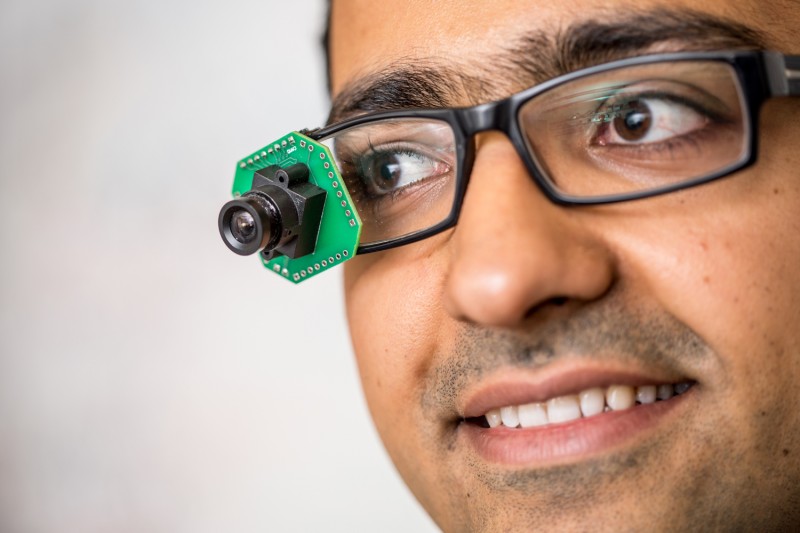
This low-power, video-streaming prototype could be used in next-generation wearable cameras, as well as in many other internet-connected devices. Dennis Wise/University of Washington
Wearable cameras such as Snap Spectacles promise to share videos of live concerts or surgeries instantaneously with the world. But because these cameras must use smaller batteries to stay lightweight and functional, these devices can't perform high-definition video streaming. Now, engineers at the University of Washington have developed a new HD video streaming method that doesn't need to be plugged in. Their prototype skips the power-hungry parts and has something else, like a smartphone, process the video instead. They do this using a technique called backscatter, through which a device can share information by reflecting signals that have been transmitted to it. "The fundamental assumption people have made so far is that backscatter can be used only for low-data rate sensors such as temperature sensors," said co-author Shyam Gollakota , an associate professor in the UW's Paul G. Allen School of Computer Science & Engineering. "This work breaks that assumption and shows that backscatter can indeed support even full HD video." The team presented these findings April 10 at the Advanced Computing Systems Association's Symposium on Networked Systems Design and Implementation.
TO READ THIS ARTICLE, CREATE YOUR ACCOUNT
And extend your reading, free of charge and with no commitment.