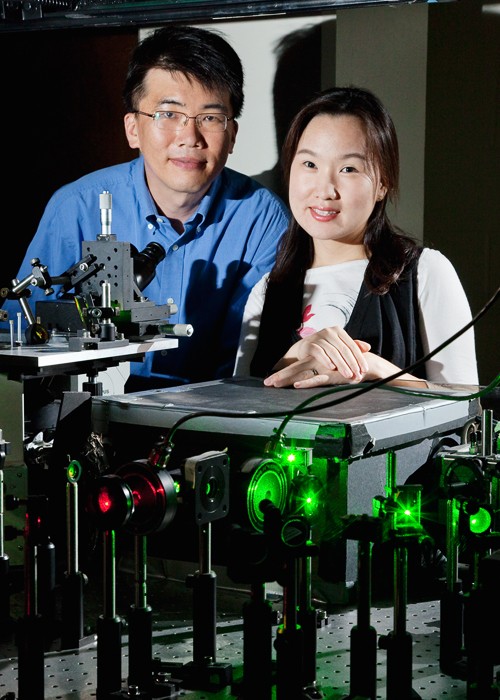
Physics professor Taekjip Ha and graduate student Jeehae Park used fluorescence resonance energy transfer to study how an important DNA enzyme regulates damages sections of DNA. The red and green fluorescent dyes allow them to track a single enzyme’s activity.
CHAMPAIGN, Ill. Thanks to a single-molecule imaging technique developed by a University of Illinois professor, researchers have revealed the mechanisms of an important DNA-regulating enzyme. Helicase enzymes are best known for 'unzipping' DNA for replication, but have many other functions for DNA repair and maintenance. The Illinois team focused on a particular bacterial helicase called PcrA involved in preventing unwanted recombination. A DNA double helix consists of two strands twisted around each other. When one strand is damaged or breaks, the surrounding area is degraded, leaving a single-stranded region. Specialized proteins then start the process of recombination - rebuilding the second strand using the intact DNA as a template.
TO READ THIS ARTICLE, CREATE YOUR ACCOUNT
And extend your reading, free of charge and with no commitment.