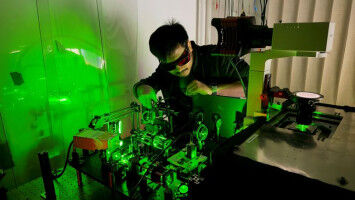
Researchers crack unassailable encryption algorithm in two hours
A protocol based on "discrete logarithms", deemed as one of the candidates for the Internet's future security systems, was decrypted by EPFL researchers. Allegedly tamper-proof, it could only stand up to the school machines' decryption attempts for two hours. Without cryptography, no one would dare to type their credit card number on the Internet. Security systems developed to protect the communication privacy between the seller and the buyer are the prime targets for hackers of all kinds, hence making it necessary for encryption algorithms to be regularly strengthened. In universities, research in hacking aim mostly at testing their robustness. Most of them rely on "discrete logarithm problems" - very complex mathematical operations - to secure data transmissions. "There are several variants, based for example on prime numbers or other mathematical formulas, explains Arjen Lenstra, director of the Laboratory for Cryptologic Algorithms (LACAL) at EPFL.