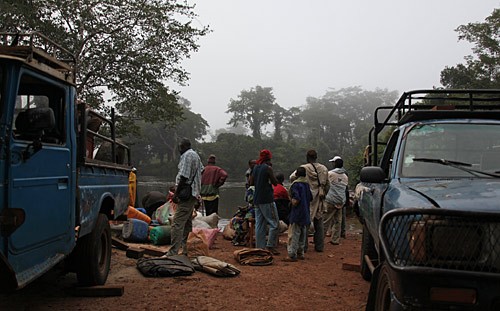
Villagers wait along the shores of one of the many rivers in the Central African Republic that lack bridges or functioning barges. Crossing is only possible using pirogues. The bad shape of the road and transportation network in the country hinders trade and exchange. A survey by researchers at UC Berkeley’s Human Rights Center found a high rate of mortality, depression and anxiety in the country.
Interviewers prepare their PDA devices before heading out into the field. The researchers adapted smartphones to help record interview responses in the Central African Republic, the first time such technology was used to conduct surveys in the country. (Patrick Vinck photos) - Print-quality images available for download - BERKELEY — Using a combination of scientific methodology and old-fashioned legwork, human rights researchers based at the University of California, Berkeley, have systematically canvassed nearly 2,000 households in the Central African Republic, carefully documenting the devastating human impact of violence in the country, as well as detailing the opinions of how the country should move forward. Their findings are detailed in a study to appear in the Aug. 4 issue of the Journal of the American Medical Association (JAMA) and in a complementary report to be released the same day by the UC Berkeley Human Rights Center. The researchers present a stark picture of a population traumatized by decades of political strife, military coups and poverty. Villagers wait along the shores of one of the many rivers in the Central African Republic that lack bridges or functioning barges.
TO READ THIS ARTICLE, CREATE YOUR ACCOUNT
And extend your reading, free of charge and with no commitment.