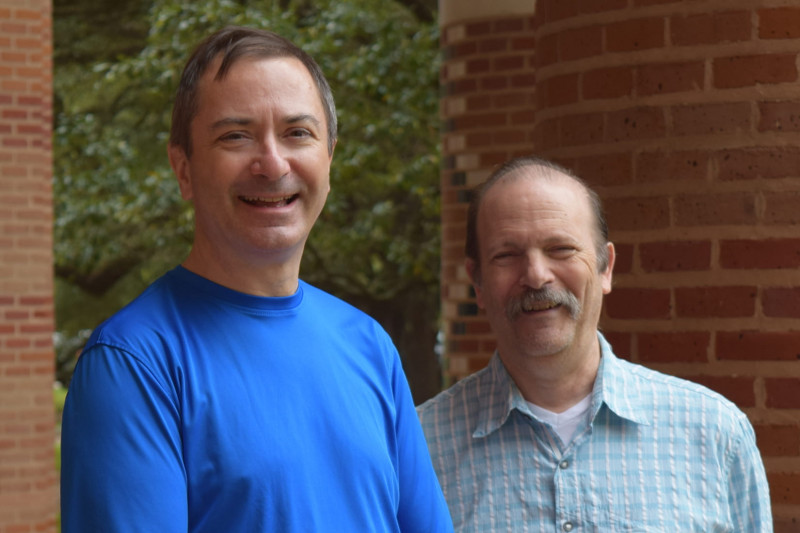
Richard Baraniuk (left) and Moshe Vardi are members of an interdisciplinary, six-university team that the Office of Naval Research has tapped to develop a theory of deep learning using a $7.5 million grant from the Department of Defense’s Multidisciplinary University Research Initiative. (Photo by Jade Boyd/Rice University)
Richard Baraniuk ( left ) and Moshe Vardi are members of an interdisciplinary, six-university team that the Office of Naval Research has tapped to develop a theory of deep learning using a $7.5 million grant from the Department of Defense's Multidisciplinary University Research Initiative. (Photo by Jade Boyd/Rice University) - DOD-funded team is developing guiding principles for popular form of AI Deep learning is an increasingly popular form of artificial intelligence that's routinely used in products and services that impact hundreds of millions of lives, despite the fact that no one quite understands how it works. The Office of Naval Research has awarded a five-year, $7.5 million grant to a group of engineers, computer scientists, mathematicians and statisticians who think they can unravel the mystery. Their task: develop a theory of deep learning based on rigorous mathematical principles. The grant to researchers from Rice University, Johns Hopkins University, Texas A&M University, the University of Maryland, the University of Wisconsin, UCLA and Carnegie Mellon University, was made through the Department of Defense's Multidisciplinary University Research Initiative (MURI). Richard Baraniuk, the Rice engineering professor who's leading the effort, has spent nearly three decades studying signal processing in general and machine learning in particular, the branch of AI to which deep learning belongs. He said there's no question deep learning works, but there are big question marks over its future.
TO READ THIS ARTICLE, CREATE YOUR ACCOUNT
And extend your reading, free of charge and with no commitment.